

Two businesses can build technically identical Fawtara connections and end up with completely different long-term outcomes, depending on which frame guided the build.
Every mandatory compliance deadline produces the same two categories of response. One group of businesses builds the minimum required to clear the deadline, treating the requirement as a cost to be minimized and closed out. The other group builds toward the same regulatory requirement, but treats the underlying system as infrastructure worth investing in properly, because the mandate happens to be forcing an upgrade the business needed anyway. Fawtara in Oman will produce both categories, and the difference between them will show up long after the deadline itself has passed.
Why the minimum-viable path costs more over time
A business that builds the smallest possible Fawtara connection, just enough to pass validation and avoid penalties, typically ends up rebuilding significant parts of that system within a year or two. This happens for a predictable reason: minimum-viable compliance builds rarely account for reconciliation, exception handling at scale, or multi-jurisdiction reuse, because those weren’t in scope for clearing the deadline. When transaction volume grows, or the business expands into another Peppol-based market, or OTA’s requirements evolve, the minimum build has to be reworked, and that rework happens under time pressure rather than as planned investment.
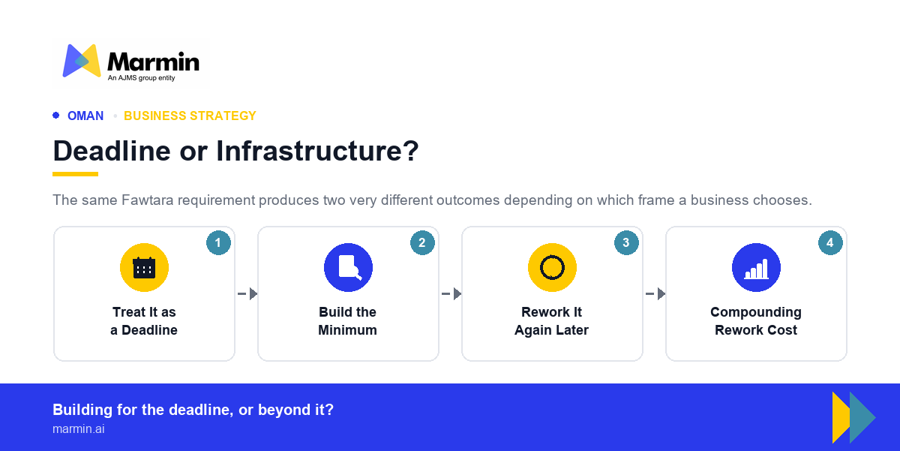
The compounding cost of treating compliance as a one-time deadline rather than infrastructure. Original graphic, Marmin brand style.
What the infrastructure frame actually changes
A business that treats the same Fawtara requirement as an infrastructure investment asks different questions from the start: does this integration handle reconciliation automatically, not just invoice submission? Does it scale cleanly as transaction volume grows rather than requiring redesign? Does the provider relationship extend to other markets the business might enter? None of these questions are required to pass OTA’s validation, but all of them determine whether the resulting system remains useful two years after go-live or needs to be rebuilt.
This is not simply a matter of spending more money upfront. Both approaches involve selecting an accredited provider and building a connection. The difference is in what gets specified and tested before go-live, and that difference costs comparatively little at build time while saving substantially at the point where minimum-viable systems typically fail.
The visibility this creates externally
There is also an external dimension worth naming. Compliance infrastructure built well is now legible to people outside a business’s own finance team, including auditors, investors, and enterprise counterparties running vendor due diligence. A business whose e-invoicing, reconciliation, and reporting systems are visibly well-integrated signals operational maturity in a way that a business scrambling to patch a minimum-viable system, three months after a near-miss compliance issue, does not.
This difference tends to become most visible during due diligence processes, whether ahead of financing, a partnership, or a larger enterprise contract. A counterparty running its own vendor assessment will typically ask how invoicing, reconciliation, and reporting connect, and a business with genuine infrastructure behind those functions answers those questions with evidence rather than assurance. Over a two or three year horizon, that difference in how a business presents itself compounds in ways that are difficult to attribute directly to the original Fawtara build decision, but trace back to it nonetheless.
Practical recommendations
- When scoping your Fawtara connection, explicitly ask whether the build addresses reconciliation and exception handling, not just invoice submission and validation.
- Evaluate providers on whether their platform scales with transaction volume growth without requiring a rebuild, not just whether it meets current volume needs.
- If your business has any regional ambitions, factor multi-jurisdiction reuse into your provider selection now, since retrofitting that later is more expensive than building for it initially.
- Treat the mandate’s deadline as a forcing function for an upgrade you likely needed anyway, rather than the entire scope of the project.
What organizations should do now
The deadline itself, April 2027 or October 2027 depending on your threshold, is fixed and cannot be negotiated. What remains a genuine choice is whether the system built to meet it is designed to last. That choice is made early, during vendor selection and initial scoping, not after go-live, which is exactly why it deserves deliberate attention now rather than being treated as a detail to resolve during implementation.
The Marmin perspective
Marmin’s platform is built around reconciliation and multi-jurisdiction operation as core features, not add-ons layered onto a minimum compliance connection. Marmin, an AJMS Group company and UAE Ministry of Finance fully approved e-invoicing service provider, serves this infrastructure-first approach across its confirmed markets, which is a relevant consideration for Omani business leaders deciding which frame will guide their own Fawtara build.
This piece reflects publicly available regulatory information as of August 2026 and is provided for general informational purposes only. It does not constitute legal, tax, or compliance advice. Organizations should confirm current requirements directly with the relevant regulator before making implementation decisions.

Leave a Reply