

OTA accreditation confirms a provider can legally operate on the network. It says almost nothing about which one is right for your business.
As of this writing, eighteen or more accredited service providers in oman are already active under Fawtara, with more moving through OTA’s accreditation process. For a CFO tasked with selecting one, the natural instinct is to treat accreditation itself as the deciding factor: find a provider on OTA’s approved list and move forward. Accreditation, however, is a floor, not a differentiator. Every provider on that list has cleared the same regulatory bar. What separates them operationally is a different set of questions entirely.
Why accreditation status answers the wrong question
Accreditation confirms a provider is legally permitted to validate and transmit invoices on OTA’s behalf. It does not indicate how well that provider’s platform integrates with your existing ERP, how effectively it surfaces reconciliation discrepancies, whether it can support operations if your business expands beyond Oman, or what security and data handling commitments it makes beyond the regulatory minimum. Two accredited providers can differ enormously on all four of these dimensions while being equally compliant on paper.
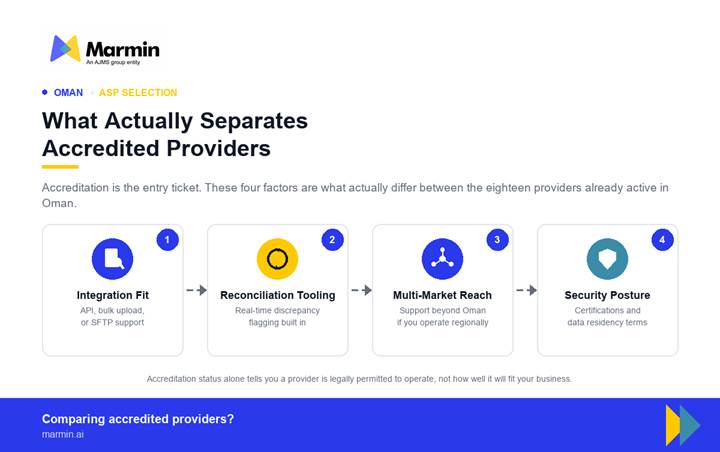
Four factors that differentiate accredited providers beyond accreditation itself. Original graphic, Marmin brand style.
Integration fit: the question most businesses skip
Providers differ in how they expect data from your business: full API integration, bulk spreadsheet upload, or SFTP file transfer, among other methods. A provider whose primary integration path assumes API-first connectivity is a poor fit for a business whose ERP cannot easily support that, and vice versa. This is worth confirming before selection, not discovered during implementation, since retrofitting an integration approach mid-project is expensive and slow.
Reconciliation tooling: the difference that shows up after go-live
Every accredited provider can submit and validate invoices. Far fewer provide real-time reconciliation tooling that flags discrepancies as they occur rather than requiring a business to build that capability separately. This difference is invisible during vendor selection, when the conversation naturally focuses on compliance capability, and becomes very visible three months after go-live, when a business discovers its reconciliation process is still largely manual despite having an accredited e-invoicing connection.
Multi-market reach and security posture
For businesses with any regional footprint beyond Oman, a provider’s experience with other Peppol-based markets, including the UAE and eventually others in the GCC, matters more than it might initially appear, since a single relationship extending across jurisdictions is typically more efficient than separate vendor relationships per country. Separately, security certifications, data residency commitments, and encryption standards vary meaningfully between providers even though none of this is captured by accreditation status itself, and these terms deserve the same scrutiny a business would apply to any vendor handling sensitive financial data.
It is worth running a structured proof of concept with two or three shortlisted providers before committing, rather than relying solely on sales presentations and reference calls. A short pilot, even a limited one covering a sample batch of real invoices, tends to surface integration friction, response times, and support quality far more reliably than any vendor’s own description of their platform. Given that the relationship established now will likely carry the business through both the voluntary pilot period and into whichever mandatory phase applies, the time spent on a genuine proof of concept is small relative to the cost of discovering a poor fit after go-live.
Practical recommendations
- Confirm a provider’s integration methods against your actual ERP capabilities before shortlisting, rather than assuming any accredited provider will fit.
- Ask specifically whether reconciliation tooling is included or requires separate build, since this is rarely volunteered in initial sales conversations.
- If you operate or plan to operate beyond Oman, ask about a provider’s track record in other Peppol-based markets specifically, not just their general company history.
- Request explicit detail on security certifications and data residency terms in writing, rather than accepting general compliance assurances.
What organizations should do now
With Phase 1 businesses required to comply from April 2027 and Phase 2 from October 2027, there is time to run a genuine evaluation process rather than defaulting to the first accredited provider encountered. That evaluation should center on the four factors above, not accreditation status, which every shortlisted provider will already satisfy by definition.
The Marmin perspective
Marmin is a certified Peppol Access Point and a UAE Ministry of Finance fully approved e-invoicing service provider, operating with ERP-agnostic connectors across API, bulk upload, and SFTP, automatic VAT and tax reconciliation with real-time discrepancy flagging, and documented security certifications including ISO 27001 and SOC 2. Marmin, an AJMS Group company, brings that combination of confirmed capabilities as one reference point for Omani businesses building their own evaluation criteria beyond accreditation status alone.
This piece reflects publicly available regulatory information as of August 2026 and is provided for general informational purposes only. It does not constitute legal, tax, or compliance advice. Organizations should confirm current requirements directly with the relevant regulator before making implementation decisions.

Leave a Reply