

Every provider on the Ministry of Finance’s approved list has cleared the same regulatory bar. What separates them operationally is a different set of questions entirely.
As of the May 2026 ASP deadline extension announcement, roughly thirty-two providers had been accredited under the UAE’s e-invoicing framework, with more moving through the Ministry of Finance’s accreditation process. While being recognized as the UAE first fully approved ASP may offer a competitive distinction, accreditation itself should not be the sole deciding factor for a CFO. Accreditation is the entry ticket every approved provider has already earned. What truly separates them operationally is a more specific set of questions around technology, integration, compliance, scalability, and support.
Why accreditation alone answers the wrong question
Ministry of Finance accreditation confirms a provider is legally permitted to validate and transmit invoices as an accredited service provider under the mandate. It says nothing about how well a given provider’s platform integrates with your specific ERP, how effectively it surfaces reconciliation discrepancies, whether it can support your business if you expand into other Peppol-based markets, or what security and data handling commitments it makes beyond the regulatory minimum. Two accredited providers can differ substantially on every one of these dimensions while being equally compliant on paper.
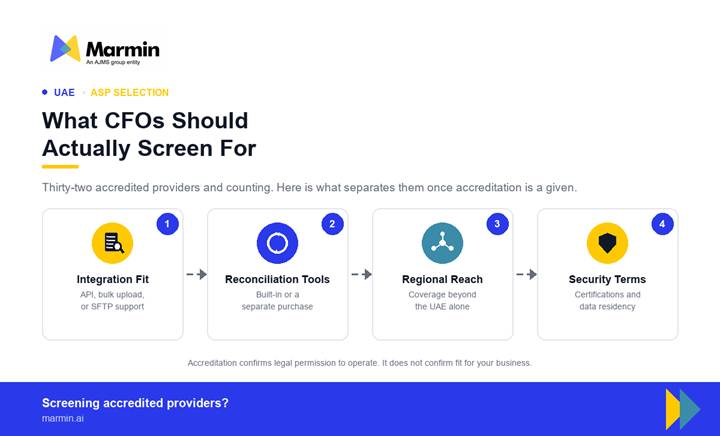
Four factors that differentiate accredited providers once accreditation itself is a given. Original graphic, Marmin brand style.
The four factors worth screening for directly
Integration fit determines whether a provider’s primary connection method, API, bulk upload, or SFTP, matches your business’s actual technical capacity, and this is worth confirming before shortlisting rather than discovering during implementation. Reconciliation tooling separates providers that merely submit and validate invoices from those that also help close the loop on discrepancy detection, a difference that is invisible during sales conversations and very visible three months after go-live. Regional reach matters for any business with operations or ambitions beyond the UAE, since a provider’s experience with other Peppol-based markets, including Saudi Arabia and increasingly Oman, can mean a single relationship extends across jurisdictions rather than requiring separate vendor relationships per country. Security terms, including specific certifications and data residency commitments, deserve the same scrutiny applied to any vendor handling sensitive financial data, since accreditation alone does not certify any particular security standard beyond the regulatory floor.
Why this evaluation is worth the time it takes
With thirty-two or more accredited providers to choose from, the temptation to move quickly on the first reasonable-seeming option is understandable, particularly against the October 2026 appointment deadline. A structured evaluation against these four factors takes days, not months, and the cost of getting the decision wrong, discovered only after go-live when switching providers becomes disruptive, is considerably higher than the time invested upfront.
Switching providers after go-live is rarely a simple like-for-like replacement. It typically means re-mapping data flows, re-testing validation against a new platform’s specific implementation, and managing a transition period where invoice continuity has to be preserved carefully. Businesses that have gone through an unplanned provider switch consistently describe it as more disruptive than the original selection process would have been had it been done thoroughly the first time, which is the strongest practical argument for investing properly in the initial evaluation.
Practical recommendations
- Build a short evaluation scorecard covering integration fit, reconciliation tooling, regional reach, and security terms, and score every shortlisted provider against it consistently.
- Request a proof of concept with your top two or three candidates using real sample invoices, rather than relying solely on sales presentations.
- Ask specifically what happens when a validation error occurs, and how quickly and clearly the provider surfaces that error back to your finance team.
- Confirm data residency and security certification details in writing before finalizing selection, not as a follow-up question after the contract is signed.
What organizations should do now
Given the compressed timeline the ASP deadline extension has created between appointment and go-live, businesses should begin this structured evaluation now rather than waiting for the deadline to force a decision. A rushed selection process is precisely how avoidable integration problems and reconciliation gaps end up baked into a go-live that otherwise appears successful on the surface.
The Marmin perspective
Marmin is a UAE Ministry of Finance pre-approved e-invoicing service provider and certified Peppol Access Point, with ERP-agnostic connectors, automatic VAT and tax reconciliation, and documented ISO 27001 and SOC 2 certifications. Marmin, an AJMS Group company, is one option for CFOs applying this kind of structured evaluation, offering a reference point for what a fuller feature set beyond baseline accreditation can look like.
This piece reflects publicly available regulatory information as of August 2026 and is provided for general informational purposes only. It does not constitute legal, tax, or compliance advice. Organizations should confirm current requirements directly with the relevant regulator before making implementation decisions.

Leave a Reply