

Most UAE e-invoicing project plans end at go-live. The real test starts the week after, once real transaction volume starts moving through the system.
Most e invoicing software in UAE implementation plans are built around a single milestone: go-live. Everything before that date gets careful project management attention. What happens after it, once real invoice volume starts flowing continuously through the new system, tends to receive far less planning, on the assumption that a successful go-live means the project is essentially complete. This assumption is where a meaningful share of post-implementation problems originate.
Why go-live and operational readiness are different milestones
Go-live confirms that a business’s systems can successfully submit invoices through an accredited service provider and have them validated by the FTA. It does not confirm that the business’s reconciliation process can absorb that invoice data at real, sustained volume without accumulating a backlog of unresolved exceptions. These are genuinely different capabilities, tested by different conditions, and a business can pass the first test cleanly while still being unprepared for the second.
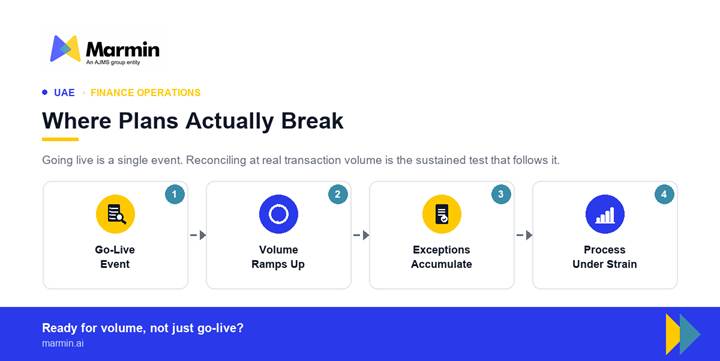
The gap between a successful go-live and sustained reconciliation readiness. Original graphic, Marmin brand style.
What actually happens as volume ramps up
In the early days after go-live, transaction volume is often lower than steady state, either because the rollout is phased internally or because counterparties are also ramping up their own e-invoicing readiness. Reconciliation looks manageable during this period, which can create false confidence. As volume increases toward normal operating levels, small process gaps that were invisible at low volume, a slightly manual exception-handling step, a validation error type nobody built a clear resolution path for, become visible bottlenecks. By the time this happens, the project team that managed the go-live has often moved on to other priorities, leaving the operational team to absorb strain that was never explicitly planned for.
Why this matters more under a continuous invoicing model
Under the UAE’s e-invoicing mandate, invoice data moves and is validated continuously, not in the periodic batches many finance teams historically reconciled against. This means reconciliation exceptions arrive continuously as well, in a steady trickle rather than a predictable batch. A process built to review exceptions weekly or monthly, carried over unchanged from before e-invoicing, is structurally mismatched to that pattern, and the mismatch only becomes apparent once real volume exposes it.
There is a useful analogy in how customer support functions evolved from ticket queues reviewed periodically to real-time chat systems expecting immediate response. The underlying skill set did not change, but the operating rhythm did, and organizations that tried to run real-time channels with a periodic-review mindset consistently underperformed. Finance reconciliation under continuous e-invoicing is undergoing a comparable shift, and the businesses that recognize it as an operating-rhythm change, not merely a technology upgrade, tend to adapt more successfully.
Practical recommendations
- Build a specific plan for the first ninety days after go-live, separate from the go-live project plan itself, focused on reconciliation performance under increasing volume.
- Define ownership for exception handling that persists beyond the initial project team, since implementation staff typically move to other work once go-live is achieved.
- Set a specific volume threshold at which you will formally review reconciliation process performance, rather than waiting for a problem to force the review.
- Test your reconciliation process against a simulated high-volume scenario before go-live if possible, using the voluntary phase or a controlled pilot to stress-test assumptions.
What organizations should do now
Businesses currently planning their UAE e-invoicing implementation should extend their project scope explicitly past the go-live date, defining what operational readiness at full volume actually looks like and who owns it. This is a modest addition to project scope relative to the disruption it prevents, and it is considerably easier to plan for in advance than to build reactively once reconciliation strain is already visible.
The Marmin perspective
Marmin’s platform includes automatic VAT and tax reconciliation with real-time discrepancy flagging, built specifically to handle exceptions as they occur rather than in periodic batches. Marmin, an AJMS Global company and UAE Ministry of Finance pre-approved e-invoicing service provider, positions this as core functionality precisely because sustained reconciliation performance, not just a successful go-live, is what determines whether an e-invoicing implementation actually succeeds operationally.
This piece reflects publicly available regulatory information as of August 2026 and is provided for general informational purposes only. It does not constitute legal, tax, or compliance advice. Organizations should confirm current requirements directly with the relevant regulator before making implementation decisions.

Leave a Reply