

OMR 5 million is not a wall between compliant and exempt. It is a date, and the businesses below it have less runway than they think.
Every phased regulatory rollout produces the same conversational shortcut. Someone in a finance meeting says the business is under the threshold, and the room quietly files the mandate under problems for later. With Fawtara, that shortcut is more costly than usual, because being under OMR 5 million in annual supplies does not mean exemption. It means an October 2027 deadline instead of an April 2027 one, and that eighteen-month gap is not the buffer it appears to be.
What the threshold actually determines
Under Decision No. 189/2026, issued by the Oman Tax Authority on 9 August 2026, e invoicing in Oman will be implemented through Fawtara’s mandatory two-phase rollout. Businesses with annual supplies exceeding OMR 5 million must comply from 1 April 2027. All remaining VAT-registered businesses, representing the majority of Oman’s VAT base, will follow from 1 October 2027. Before this decision, earlier commentary had described a four-phase rollout starting as early as August 2026 for a narrow group of large taxpayers. That earlier framework has been superseded, and the current binding structure is the two-phase split outlined above.
The threshold is a filing and reporting question, based on annual supplies, not a company size or industry classification. A business can be well under OMR 5 million in revenue and still be squarely in scope for the October 2027 deadline. The only businesses genuinely outside Fawtara’s scope entirely are those not VAT-registered at all, which in practice is a small minority of active commercial entities in Oman.
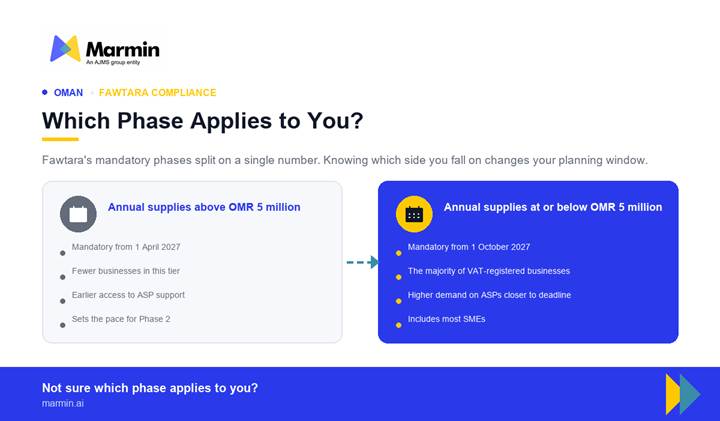
The two mandatory Fawtara phases, split by annual supplies. Original graphic, Marmin brand style.
Why the later deadline is not extra safety margin
There is a structural reason the October 2027 group should not treat their extra six months as slack. The businesses in that tier vastly outnumber those in the April 2027 group, since most VAT-registered entities in Oman fall below the OMR 5 million threshold. That means accredited service providers, system integrators, and internal finance teams across the country will all be competing for the same implementation resources in the months leading up to October 2027, exactly when demand is highest.
Businesses that begin evaluating providers and preparing their systems now, well ahead of their own deadline, are choosing from a less contested field and working with implementation teams who are not simultaneously managing dozens of other last-minute onboardings. This is not a hypothetical risk. It is a predictable consequence of how phased mandates concentrate demand near deadlines, visible in comparable rollouts in other markets.
The reconciliation question that outlasts the date
Regardless of which phase a business falls into, the OMR 5 million threshold says nothing about invoice volume readiness. A business just under the threshold with a high transaction count faces a materially different operational challenge than a business well over the threshold with low transaction volume but higher-value invoices. The threshold determines your deadline. It does not determine how hard the reconciliation and validation work will be once you are live, and that work scales with transaction count, not revenue.
Practical recommendations
- Confirm which phase applies to your business based on annual supplies, not company size or industry assumptions, and document that determination formally.
- If you fall into the October 2027 group, begin ASP evaluation on the same timeline as businesses in the April 2027 group rather than waiting, since implementation capacity will tighten as the deadline approaches.
- Assess your actual invoice transaction volume separately from your revenue figure, since volume, not revenue, is what determines the operational complexity of your Fawtara connection.
- Revisit your threshold classification periodically, since annual supplies can shift a business between phases if growth or contraction moves it across the OMR 5 million line.
What organizations should do now
The practical planning window for either phase is shorter than the calendar suggests, because vendor selection, ERP connectivity work, and internal process change all take months regardless of which deadline applies. Organizations that start this work based on a realistic view of implementation capacity, not just the calendar date attached to their revenue tier, arrive at their go-live date with materially less risk than those who wait for the deadline itself to create urgency.
The Marmin perspective
A single, accredited layer that connects compliance, finance operations, and data integrity is increasingly what organizations need regardless of which Fawtara phase they fall into, rather than a rushed, deadline-driven integration built under pressure. Marmin, an AJMS Group company, operates as a certified Peppol Access Point and is a UAE Ministry of Finance pre-approved e-invoicing service provider, with direct operating experience in the same Peppol architecture Fawtara is built on. That experience is a relevant reference point for Omani finance teams planning their own timeline, whichever threshold applies to them.
This piece reflects publicly available regulatory information as of August 2026 and is provided for general informational purposes only. It does not constitute legal, tax, or compliance advice. Organizations should confirm current requirements directly with the relevant regulator before making implementation decisions.

Leave a Reply