

Fawtara isn’t a bespoke Omani system built from scratch. Understanding why OTA chose the Peppol network changes how you should plan for it.
When businesses in Oman first encounter Fawtara, the instinct is to treat it as a new, standalone government portal to connect to, similar to a VAT return system or a customs filing tool. That framing misses something important. Fawtara is not a bespoke Omani invention. It is implementation of Peppol five-corner model in Oman, an international electronic document exchange framework already used across Europe, Singapore, Australia, and increasingly the GCC. Understanding that choice changes how a business should plan its connection, because the architecture was not designed by OTA from a blank page. It was adopted, and adoption comes with both advantages and constraints worth understanding upfront.
Why the network matters more than the portal
The Oman Tax Authority became an official Peppol Authority in January 2026 and published its Oman-specific technical specification, PINT-OM, in April 2026. Structurally, Fawtara uses what is called a five-corner model. An invoice originates with the supplier, passes to the supplier’s accredited service provider for validation, travels across the Peppol network itself, reaches the buyer’s accredited service provider, and finally arrives at the buyer. Both service providers simultaneously transmit a Tax Data Document to OTA, which is the fifth corner in the model and the reason it differs from the simpler four-corner Peppol design used in some other markets.
The practical consequence is that your invoice never travels directly to your counterparty. It travels through at least two intermediary validation points and a shared network layer before arriving. For a business used to point-to-point EDI connections or emailed PDF invoices, this is a meaningfully different data flow to design around, not simply a new destination to send files to.
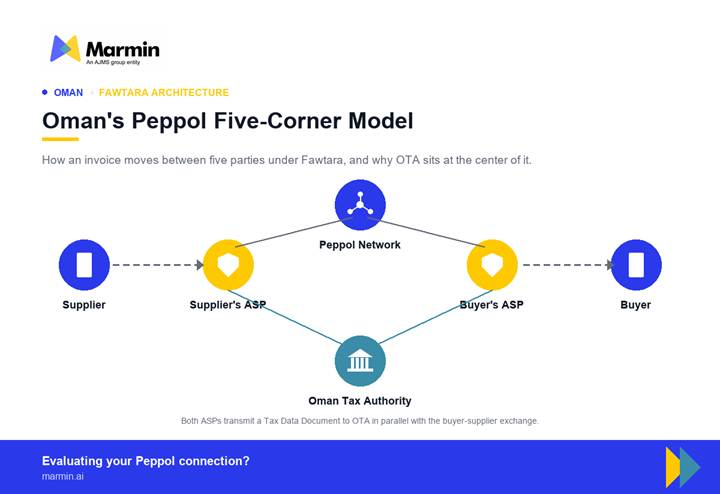
The Peppol five-corner model underlying Fawtara. Original graphic, Marmin brand style.
What adopting an existing standard buys Oman, and you
There is a genuine advantage to OTA building on an established network rather than inventing one from scratch. Peppol’s four-corner model has years of production use across multiple jurisdictions, meaning the core validation and transport mechanics are proven technology, not an unproven government IT project. PINT-OM itself is described as aligned with EN 16931, the European standard underlying most Peppol implementations, which means the underlying data model is not unique to Oman.
This matters practically for any business that already operates, or plans to operate, in another Peppol-based market. The same five-corner logic, with local variations in tax field requirements and authority reporting, is spreading across the region. A Peppol connection built well for Oman is not necessarily a one-off investment specific to this single mandate.
Where the complexity actually sits
The complexity in a Peppol-based system rarely lives in the network transport itself. It lives in two places: getting your outgoing invoice data correctly formatted against PINT-OM’s schema before it ever reaches your accredited service provider, and correctly interpreting the validation responses and Tax Data Document confirmations that come back. Businesses that treat their ASP as a black box that simply handles compliance often discover, only once volume increases, that their own data quality and internal exception-handling process is the actual bottleneck.
This is why evaluating an ASP purely on accreditation status is insufficient. The accreditation confirms the provider is legally permitted to operate on the network. It says nothing about how well their platform surfaces validation failures back to your finance team, how their reconciliation tooling handles exceptions, or how their support model behaves when something in your own outgoing data is malformed.
Practical recommendations
- Map your current invoice generation process against PINT-OM’s field requirements before selecting a provider, rather than assuming any accredited ASP will simply handle the translation invisibly.
- Ask prospective providers how validation failures are surfaced back to your team, and how quickly, since this determines how fast your finance staff can correct and resubmit.
- If you operate, or plan to operate, in other Peppol-based markets, evaluate whether a single provider relationship can extend across those jurisdictions rather than building separate connections per country.
- Treat the Tax Data Document confirmation from OTA as a reconciliation input, not just a compliance receipt. It is data your finance systems should actually consume.
What this means for planning
Because Fawtara is built on an existing, proven network rather than a new one, the technology risk in adopting it is lower than headlines about a new government mandate might suggest. The real planning work is internal: getting your own invoice data model, ERP configuration, and exception-handling process ready for a five-corner flow rather than the point-to-point or manual processes many Omani businesses currently rely on. That internal readiness work, not the external network, is what determines how smooth your transition through the pilot and into the mandatory phases will be.
The Marmin perspective
Organizations preparing for mandatory e-invoicing increasingly need a platform that treats Peppol connectivity as core infrastructure, built once and extended across markets, rather than a fresh integration project for every jurisdiction. Marmin, an AJMS Global company, operates as a certified Peppol Access Point and is a UAE Ministry of Finance pre-approved e-invoicing service provider, giving it direct operating experience with the same five-corner architecture Fawtara is built on. For Omani finance and IT teams evaluating providers, that cross-market Peppol experience is a useful reference point when assessing how a platform actually behaves in production.
This piece reflects publicly available regulatory information as of August 2026 and is provided for general informational purposes only. It does not constitute legal, tax, or compliance advice. Organizations should confirm current requirements directly with the relevant regulator before making implementation decisions.

Leave a Reply