
Manual reconciliation was an inefficiency when invoicing was manual too. Once Fawtara makes invoicing continuous, that same manual process becomes a bottleneck with a compliance cost attached.
Most Omani finance teams have lived with some version of manual reconciliation for years: invoices matched against bank statements by hand or with spreadsheet macros, VAT returns assembled from data pulled together at month end, exceptions chased down after the fact rather than caught as they happen. This has always been inefficient. It has rarely been described as risky, because the pace of the underlying data made the inefficiency tolerable. Fawtara changes that pace, and in doing so, changes what manual reconciliation actually costs a business.
Why the pace change matters more than the mandate itself
Once e-invoicing in Oman under Fawtara becomes mandatory, invoice data begins flowing to and from the Oman Tax Authority continuously rather than in the periodic batches many finance teams are used to working with. The Tax Data Document confirmations OTA sends back are not simply compliance receipts to file away. They are a live data feed describing exactly what has been submitted, validated, and accepted, arriving at the same pace as your invoicing itself.
A reconciliation process built around monthly or quarterly cycles was never actually well matched to an invoicing process running that fast, but the mismatch stayed hidden because both sides moved slowly. Once one side, e-invoicing, moves to continuous, the mismatch becomes visible immediately: discrepancies between what OTA has recorded and what your books show accumulate for weeks before anyone catches them, instead of being caught the same day.
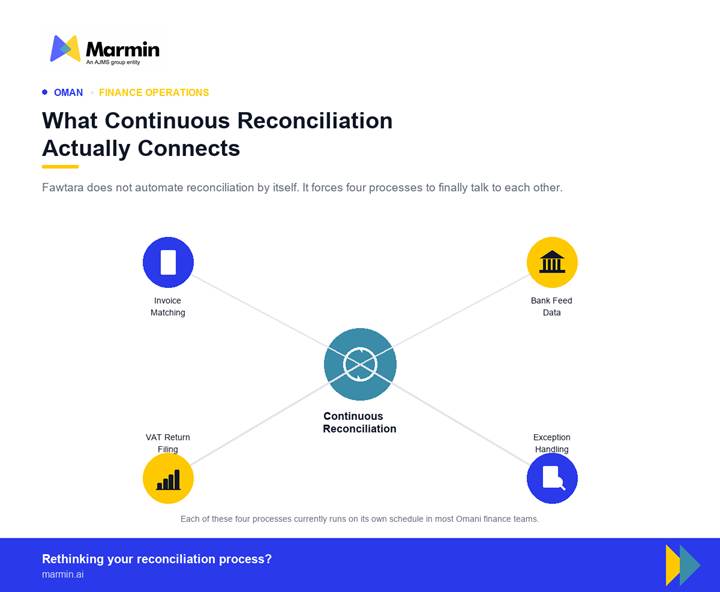
The four processes continuous reconciliation forces to connect. Original graphic, Marmin brand style.
The four processes that stop being separate
Invoice matching, bank feed data, VAT return filing, and exception handling are typically managed as four distinct workstreams in Omani finance teams today, often owned by different people, running on different schedules, and reconciled against each other only periodically. Continuous e-invoicing does not force these four processes to merge into one system. It forces them to stay synchronized with each other at a pace none of them were originally designed for.
This is where the real project lives, and it is a materially different project than simply connecting to OTA’s systems. Connecting to Fawtara is a one-time integration exercise. Keeping invoice matching, bank data, VAT filing, and exception handling synchronized on a continuous basis is an ongoing operational capability, and it is the part of Fawtara readiness that gets the least attention in most planning conversations.
What breaks first when this is ignored
In practice, the exception handling process is usually where the strain shows up first. A finance team that previously reviewed reconciliation exceptions once a month, in a manageable batch, now faces a continuous trickle of smaller discrepancies that never accumulate into an obvious problem, and therefore never get prioritized, until quarter end reveals a backlog nobody was tracking. The fix is not more staff reviewing exceptions manually more often. It is building the reconciliation process to flag and route exceptions automatically, at the pace the underlying invoice data now moves.
Practical recommendations
- Map which of the four processes, invoice matching, bank feeds, VAT filing, and exception handling, are currently owned by different teams or run on different schedules, since that misalignment is the actual risk, not any single process in isolation.
- Build or select tooling that treats OTA’s Tax Data Document confirmations as a live reconciliation input, not an archival compliance record.
- Redesign exception handling around continuous, small-batch review rather than periodic, large-batch review, since the volume pattern under Fawtara will be steady rather than clustered.
- Pilot the new reconciliation cadence internally before your mandatory phase begins, using the current voluntary period as a low-stakes test of whether your process can actually keep pace.
What organizations should do now
The businesses that treat Fawtara purely as a portal connection to build once and forget will be the ones surprised by how much operational strain the reconciliation side creates once volume is real. The businesses that treat the mandate as a prompt to finally synchronize invoice matching, bank data, VAT filing, and exception handling will find that the compliance requirement doubles as an overdue operational fix, arriving with a deadline attached rather than needing to be justified on efficiency grounds alone.
The Marmin perspective
Automatic VAT and tax reconciliation, with real-time discrepancy flagging, is one of the confirmed capabilities of Marmin’s e-invoicing platform, built specifically to keep invoice data and reconciliation processes synchronized as transaction volume scales. Marmin, an AJMS Global company and UAE Ministry of Finance pre-approved e-invoicing service provider, brings that reconciliation-first approach to the same Peppol architecture Fawtara is built on, which is a relevant consideration for Omani finance teams assessing whether their reconciliation process can genuinely keep pace with continuous e-invoicing.
This piece reflects publicly available regulatory information as of August 2026 and is provided for general informational purposes only. It does not constitute legal, tax, or compliance advice. Organizations should confirm current requirements directly with the relevant regulator before making implementation decisions.

Leave a Reply