

B2G e-invoicing has its own mandatory date. Businesses tracking only the general B2B timeline can miss it entirely.
Most discussion of UAE e-invoicing deadlines centers on the B2B timeline: large businesses from January 2027, smaller businesses from July 2027. Businesses that transact with government entities need to track a third, distinct date, since B2G transactions become mandatory from 1 October 2027, under a separate scope provision from the general B2B phases. A finance team that has only mapped its B2B exposure may be tracking the wrong deadline entirely for its government-facing revenue.
Why B2G sits on its own timeline
The scope and framework set out under Ministerial Decisions No. 243 and 244 of 2025 distinguish between B2B and B2G transaction categories, with B2G following its own phase. This is a common pattern in e-invoicing mandates generally, since government reporting and procurement systems often have their own integration requirements distinct from the broader business population, but it means a business cannot simply assume its B2B compliance timeline automatically covers its government contracts as well.
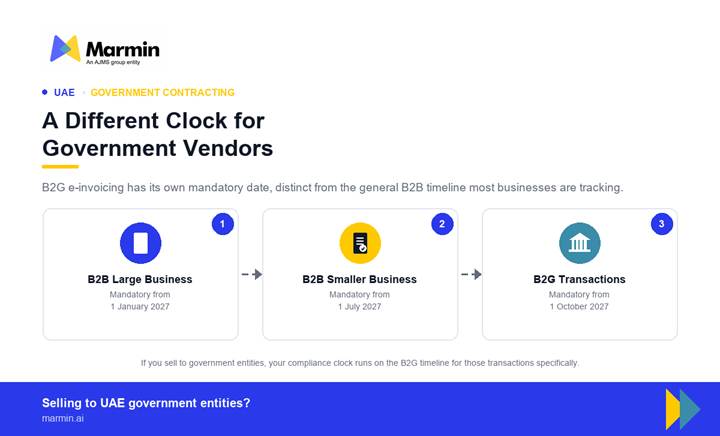
The three distinct UAE e-invoicing timelines: large B2B, smaller B2B, and B2G. Original graphic, Marmin brand style.
Who this actually affects
Any business with government contracts, regardless of its size classification under the AED 50 million B2B threshold, needs to plan for the October 2027 B2G date specifically for that portion of its revenue. A mid-sized business primarily serving private-sector clients but with a smaller government contract could find itself managing two different compliance timelines simultaneously: its own B2B deadline based on total revenue, and the separate October 2027 date for its government-facing transactions specifically.
This dual-timeline reality is easy to miss precisely because most planning materials, including much of the public commentary on the mandate, discuss B2B and B2G as a single undifferentiated e-invoicing rollout. Finance teams reading only the headline dates may reasonably conclude their business is covered once their B2B classification is sorted out, without realizing the B2G portion of their revenue runs on its own separate clock.
Why October 2027 deserves attention now, not later
Government procurement and invoicing processes often involve additional integration requirements, approval workflows, or reporting formats specific to public sector counterparties, on top of the general PINT AE and validation requirements that apply broadly. Businesses with meaningful government revenue should treat this as a distinct workstream within their broader e-invoicing project, not an assumed byproduct of general B2B readiness.
Given that B2G’s mandatory date falls after both B2B phases, there is a reasonable temptation to deprioritize it entirely in favor of the more immediate B2B deadlines. This is understandable sequencing, but it carries a risk: government procurement cycles can be long, and a business bidding on or renewing government contracts in 2027 may find itself needing to demonstrate B2G e-invoicing readiness as part of that process well before the formal October deadline actually arrives, particularly if government counterparties begin favoring vendors who can show early compliance.
Practical recommendations
- Identify what share of your revenue comes from government entities, and confirm whether your e-invoicing implementation plan currently accounts for the separate October 2027 B2G deadline.
- Ask your accredited service provider directly whether their platform supports B2G-specific requirements, since not every provider’s roadmap treats this as equally mature as B2B support.
- Build B2G readiness as an explicit line item in your project plan, rather than assuming it is automatically covered by general B2B compliance work.
- Engage with any government counterparties directly about their own e-invoicing expectations and timeline, since public sector entities may have additional guidance beyond the general mandate.
What organizations should do now
Businesses with any meaningful government contracting revenue should confirm their B2G exposure and treat October 2027 as a real, separate deadline requiring its own planning, rather than an afterthought to their broader B2B compliance project. Given how much of the public conversation focuses on the B2B timeline, this is exactly the kind of gap that tends to surface late, when correcting it is more disruptive.
The Marmin perspective
This piece has focused on a scope distinction within the UAE e-invoicing mandate itself, relevant to any business with government contracting revenue regardless of which accredited service provider they ultimately select. Businesses should confirm B2G-specific support directly with any provider under consideration, including Marmin, as part of their broader ASP evaluation process.
This piece reflects publicly available regulatory information as of August 2026 and is provided for general informational purposes only. It does not constitute legal, tax, or compliance advice. Organizations should confirm current requirements directly with the relevant regulator before making implementation decisions.

Leave a Reply