

Most businesses assume connecting to Fawtara is a plugin or an API call away. The real work is redesigning how data flows between four distinct layers.
When a CIO first scopes a Fawtara connection project, the instinct is to treat it as a single integration task: connect the ERP to Oman Tax Authority and move on. In practice, the connection is better understood as four distinct layers, each with its own failure modes, and the friction that slows most implementations down happens not inside any one layer but at the handoff points between them.
The four layers, and why they are not one problem
The first layer is authentication: secure, token-based access established before every API interaction, so that submissions can be trusted as coming from an authorized source. The second is data formatting: translating whatever structure your ERP natively produces into the PINT-OM schema OTA requires. This is rarely a one-to-one field mapping and often surfaces gaps in how your ERP currently captures invoice data. The third is validation: your accredited service provider checking submitted data against OTA’s business rules before it is accepted. The fourth is confirmation synchronization: taking the Tax Data Document that comes back and feeding it into your own systems as usable data, not just an archived receipt.
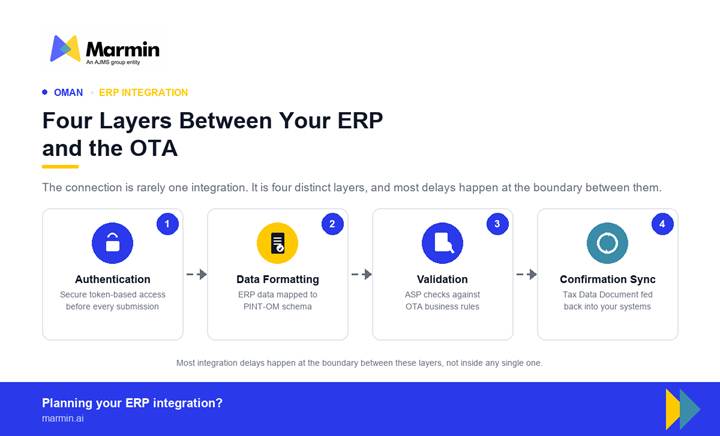
The four layers between an ERP and the Oman Tax Authority. Original graphic, Marmin brand style.
Where projects actually lose time
Authentication and validation are usually the layers that get the most attention during planning, because they are the most visibly technical and the easiest to describe in a project scope. Data formatting and confirmation synchronization are where most real-world delays happen, precisely because they are less visible. Data formatting delays surface when a business discovers, partway through implementation, that fields OTA requires are not consistently populated in their current invoicing process, forcing a redesign of upstream data entry rather than a simple mapping exercise.
Confirmation synchronization delays are even less anticipated. Many implementation plans treat the Tax Data Document response as the end of the process, something to store for audit purposes. Few plan for actually consuming that data back into reconciliation or ERP records automatically, which means the confirmation loop stays manual long after the submission side has been automated, quietly recreating the same reconciliation gap the rest of the project was meant to close.
Why this is an architecture decision, not a configuration task
None of this means the connection is unusually difficult. It means the connection is better planned as an architecture decision covering how data flows in both directions, not a configuration task limited to submitting invoices outward. Businesses that scope the project only as the outward path, from ERP to OTA, tend to underestimate the work by roughly half, because the inward path, from OTA’s confirmations back into usable business data, carries its own design requirements.
The deployment method a business chooses also shapes how much of this architecture work falls on internal IT versus the accredited service provider. A full API integration puts more of the formatting and error-handling logic inside the business’s own systems, which offers more control but requires more internal engineering capacity. Bulk upload or SFTP-based approaches shift more of that translation work to the provider’s platform, trading some control for a faster initial build. Neither approach is inherently better, but the choice should be made deliberately, based on available internal capacity, rather than defaulting to whichever method a shortlisted provider happens to lead with in early sales conversations.
Practical recommendations
- Scope your Fawtara integration project as four layers, authentication, data formatting, validation, and confirmation synchronization, rather than a single connection task, and assign clear ownership for each.
- Audit your ERP’s current invoice data against PINT-OM’s field requirements early, since data formatting gaps are the most common source of delayed timelines.
- Design the confirmation synchronization path with the same rigor as the submission path, so Tax Data Document responses feed automatically into reconciliation rather than sitting as unused archive records.
- Use the voluntary pilot period to test all four layers end to end before your mandatory deadline, not just the outward submission path.
What organizations should do now
The businesses that get furthest ahead of their Fawtara deadline are not necessarily the ones with the most technically sophisticated integration. They are the ones who scoped the project correctly from the start, understanding that a working connection means data flowing cleanly in both directions, not just successfully submitting invoices outward. Getting that scope right early avoids the common pattern of a project that looks complete because invoices are being accepted, while reconciliation and confirmation handling remain quietly manual behind the scenes.
The Marmin perspective
Marmin’s platform is built with ERP-agnostic connectors and multiple deployment options, including API, bulk upload, and SFTP, specifically because the connection between a business’s existing systems and a tax authority is rarely a single clean integration path. Marmin, an AJMS Global company and certified Peppol Access Point, brings that flexibility to the same architecture Fawtara is built on, which is worth factoring into how Omani finance and IT teams scope their own four-layer connection project.
This piece reflects publicly available regulatory information as of August 2026 and is provided for general informational purposes only. It does not constitute legal, tax, or compliance advice. Organizations should confirm current requirements directly with the relevant regulator before making implementation decisions.

Leave a Reply