
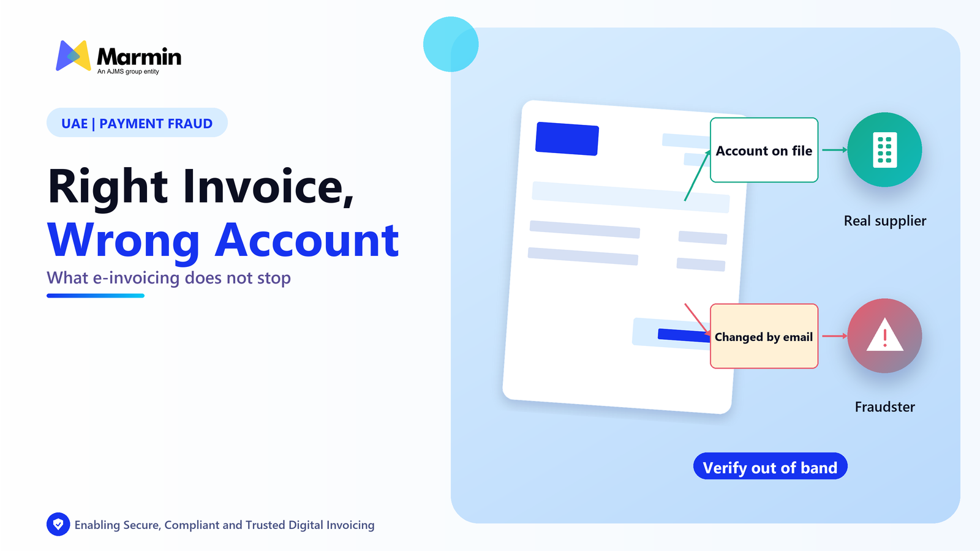
A structured e-invoice exchanged over a trusted network is a real improvement on a PDF in an email. It makes forged lookalike invoices harder to slip into a payment run and removes a lot of manual re-keying. But payment redirection fraud does not need a forged invoice. It needs one thing: a changed bank account that someone in your business believes.
This article explains where the fraud actually happens, what the data says about its scale, and which controls sit in your vendor master data and payment approvals rather than in the invoice exchange itself.
What the UAE model does and does not do
The UAE Guidelines describe a five-corner model in which a supplier’s Accredited Service Provider validates the invoice, sends it to the buyer’s provider and reports tax data to the Federal Tax Authority. Providers verify the businesses they onboard against the Authority’s records. That helps establish who is exchanging invoices. It does not tell you whether a supplier’s bank details in your vendor master are the ones the supplier really uses, and it does not stop an employee of yours from being persuaded by an email that says they have changed.
No official source we reviewed says that e invoicing software in UAE eliminates invoice fraud or guarantees authenticity, and content should not claim it does.
How big is the problem?
The FBI’s Internet Crime Complaint Center published its 2025 report in April 2026. It records 24,768 business email compromise complaints in 2025 with reported losses of about 3.05 billion US dollars, up from about 2.77 billion in 2024. The report’s chart of transaction types for business email compromise complaints shows wire or ACH transfers at about 86 percent. Two cautions apply: these are victim-reported complaints, mostly from the United States, and business email compromise covers more than invoice fraud. They show the scale and shape of the threat, not a UAE-specific loss figure. The report defines business email compromise as a scam targeting businesses and individuals who work with suppliers or regularly perform wire transfers, carried out by compromising email accounts and other forms of communication through social engineering or intrusion.
Three scenarios the invoice exchange cannot catch
| Scenario | What happens | Where the control sits |
| Email after a real invoice | A genuine e-invoice arrives through the network. A day later an email, copying the real invoice number, asks you to pay a new account | Bank-detail change procedure in accounts payable |
| Compromised supplier mailbox | A fraudster inside your supplier’s email thread sends a convincing change request from the real address | Verification through an independently sourced second channel |
| Compromised supplier system | Someone alters the payment details in the invoice data before it is sent, so the network delivers a valid but poisoned document | Comparison of the invoice’s payment details to your vendor master before payment |
Controls that work, and where recommended practice comes from
The FBI’s public service announcement on business email compromise advises using secondary channels or two-factor authentication to verify requests for changes in account information. The UK National Cyber Security Centre says to verify important email requests using a second type of communication, and suggests telling suppliers and customers what to watch for, for example that your bank details will not change. Europol’s guidance recommends a procedure to verify the legitimacy of payment requests received by email and advises staff not to skip steps or give in to pressure. These are recommended practices, not UAE legal requirements.
Security implications and recommendations
- Lock down vendor master changes. Require two people, one to enter and one to approve, and record the evidence of verification.
- Verify through a number you already hold, never one supplied in the request.
- Compare payment details in each e-invoice to the vendor master. Hold payment on any mismatch, even from a trusted supplier.
- Add a cooling-off period and extra approval for the first payment to a changed account or a high-value payment.
- Prepare the recall routine. The FBI report stresses that time is of the essence: contact your bank immediately to request a recall and report the incident.
- Tell your suppliers how bank detail changes should be requested and confirmed.
What a bank-detail change procedure should say
A one-page procedure is enough if it is specific. It should say who may enter a change and who must approve it, which independent channel must be used to confirm it, what evidence is stored, how long a new account is held before the first payment and who may authorise an exception. It should also say that a request received by email, even from a known address, is never sufficient on its own. Auditors and insurers tend to ask for exactly this document after an incident.
Conclusion
E-invoicing platform in UAE improves the integrity of the document. Payment fraud attacks the decision to pay. The two need different controls, and the second set lives in your vendor master, your approval workflow and your people.
A finance team that treats every bank-detail change as a security event will be far harder to defraud, whatever format the invoice arrives in.
Marmin AI Software Design LLC appears on the UAE Ministry of Finance’s published list of Accredited Service Providers. If you would like an independent look at how your e-invoicing connections handle security, speak to Marmin’s UAE team about a technical review.
SOURCES AND REFERENCES
- 2025 Internet Crime Report. FBI Internet Crime Complaint Center, April 2026. https://www.ic3.gov/AnnualReport/Reports/2025_IC3Report.pdf
- Business Email Compromise: The $55 Billion Scam (PSA I-091124-PSA). FBI Internet Crime Complaint Center, 11 September 2024. https://www.ic3.gov/PSA/2024/PSA240911
- Phishing attacks: defending your organisation. UK National Cyber Security Centre (reviewed 13 February 2024). https://www.ncsc.gov.uk/guidance/phishing
- Business payment fraud. UK National Cyber Security Centre. https://www.ncsc.gov.uk/section/respond-recover/business-payment-fraud
- CEO/Business Email Compromise (BEC) Fraud (leaflet, 2018). Europol. https://www.europol.europa.eu/cms/sites/default/files/documents/4_ceo-bec_fraud.pdf
- UAE Electronic Invoicing Guidelines, Version 2.0 (26 October 2026). UAE Ministry of Finance. https://mof.gov.ae/wp-content/uploads/2026/10/UAE-Electronic-Invoicing-Guidelines_En.pdf
Regulatory content reflects UAE Ministry of Finance, Federal Tax Authority and OpenPeppol documents as of 10 November 2026. Where this piece describes the PDPL, the cybercrime law or sector rules, it relies on secondary commentary because the official text could not be retrieved; please have UAE counsel confirm before external publication. Fraud statistics are US-centric complaint data and are not UAE loss figures.

Leave a Reply