
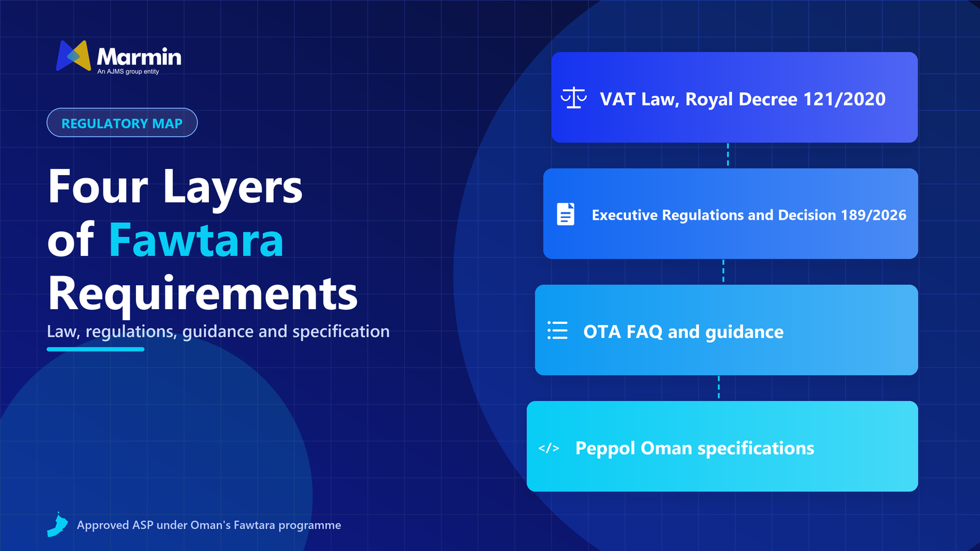
When a requirement is described as “a Fawtara rule”, it is worth asking where it actually comes from. In Oman e-invoicing obligations draw on four different kinds of source, and they do not carry the same weight. Some are law. Some are guidance that the Tax Authority updates monthly. Some are technical specifications published by OpenPeppol for the Oman Tax Authority.
Mixing them up leads to two kinds of mistakes: treating a technical detail as a legal duty, or treating a legal duty as an optional technical preference. This article maps the four layers and shows which questions each one answers.
Layer one: the VAT Law
The VAT Law, issued by Royal Decree 121/2020, sets the foundations. Article 67 requires a taxable person to issue a tax invoice when making a supply, including a deemed supply, or when receiving consideration before the date of supply. Article 68 deals with invoices in foreign currency, with the tax value converted to Omani rials at the Central Bank of Oman rate. Article 70 sets the retention period: 10 years following the end of the tax year in which the return is filed, and 15 years for records relating to real estate.
Layer two: the Executive Regulations
The Executive Regulations turn the law into operating rules, and Decision 189/2026 amends them. This is where the duty to issue the invoice in an approved and secured electronic format sits, along with the 15 day issuance window, the announcement of licensed providers and the two start dates, 1 April 2027 and 1 October 2027.
Layer three: Tax Authority guidance
The Oman Tax Authority’s Fawtara FAQ is the main guidance document. Its September 2026 version, and the web version updated on 28 October 2026, address practical questions. Examples include that invoices must be issued in XML as the structured format, that a PDF is not an e-invoice, that business to business reporting is real time and business to consumer reporting is within 24 hours, that a QR code is required on business to consumer invoices and on invoices to buyers who are not VAT-registered, that the Tax Authority charges no fees, and that archiving remains the taxpayer’s responsibility.
This layer is authoritative about how the Tax Authority expects the system to work, but it is not law and it is updated from time to time. Some older pages on the Tax Authority’s site still show earlier statements, so the dated PDF and the date shown on each page matter.
Layer four: the Peppol Oman specifications
The technical detail comes from specifications published by OpenPeppol for Oman: the Solution Reference Architecture, the Peppol Authority Specific Requirements for service providers, and the PINT OM specifications for billing, self-billing and the Tax Data Document. They define the UBL 2.1 syntax, document types, identifiers, validation rules and message flows.
One map to keep on the wall
| Question | Where the answer sits | Weight |
| Must we issue a tax invoice for this event? | VAT Law, Article 67, and Executive Regulations, Article 143 | Law |
| By when must it be issued? | Executive Regulations, Article 143 as amended | Law |
| How long must we keep it? | VAT Law, Article 70 | Law |
| What start date applies to us? | Decision 189/2026, Article 3, plus the FAQ method for the OMR 5 million test | Law plus guidance |
| Which file format and exchange network? | OTA FAQ and the Peppol Oman specifications | Guidance and specification |
| How are credit notes and self-billed invoices structured? | PINT OM specifications | Specification |
| How fast must reporting be? | OTA FAQ, with service provider service levels in the Peppol requirements | Guidance and specification |
Why a source log is worth keeping
Specifications are versioned and guidance is refreshed, so a requirement that was accurate in July may have been refined by October. A simple log that records each requirement, its source, the version or date you read, and the person who checked it gives your finance and IT teams a shared reference. It also makes audits of your own readiness plan far easier.
A useful habit: When a vendor, article or colleague states a Fawtara requirement, ask for the document and section it comes from. If it is a vendor feature rather than an Oman Tax Authority requirement, that is perfectly acceptable, but it should be labelled as such.
A worked example: do we invoice an advance payment?
Imagine a finance director asking whether an advance payment from a customer needs an e-invoicing service provider. Walking down the layers gives a complete answer. The law and regulations say yes: Article 67 of the VAT Law and Article 143 of the Executive Regulations tie the invoice to receipt of consideration, in full or in part, before the date of supply. The Tax Authority’s guidance says e-invoices should be issued for transactions where an invoice is required under the VAT legislation. The Peppol Oman specification then provides a prepayment transaction type, which carries the prepaid amount and a reference to the related invoice. Each layer contributes a different part of the answer, and none of them would be sufficient alone.
Conclusion
The four layers answer different questions. The law tells you what you must do, the regulations when you must do it, the guidance how the Tax Authority expects the system to behave, and the specifications how the data must be shaped.
Businesses that keep the layers distinct tend to ask better questions of their providers and to avoid both over-engineering and under-preparing.
Marmin AI team can help you build a source log that maps each Fawtara requirement to its official document. Speak to our Oman team to get started.
SOURCES AND REFERENCES
- Oman Value Added Tax Law, Royal Decree 121/2020 (English translation). Oman Tax Authority. https://tms.taxoman.gov.om/portal/documents/20126/1414820/VAT+Law+.pdf/9cbe8926-066b-d48d-2b7f-14f41b4c19a8?t=1733169733344
- Decision No. 189/2026 amending certain provisions of the VAT Executive Regulations (Arabic text), Official Gazette issue 1660. Oman Tax Authority, published by the Ministry of Legal Affairs. https://www.mjla.gov.om/images/decisions/file/Book934177.pdf
- Fawtara (E-invoicing) Frequently Asked Questions, version dated 30 September 2026. Oman Tax Authority. https://tms.taxoman.gov.om/portal/documents/d/taxportal/monthly-faq-s-september-
- E-invoicing FAQs, web page last updated 28 October 2026. Oman Tax Authority Tax Portal. https://tms.taxoman.gov.om/portal/e-invoicing-faq
- Oman Solution Reference Architecture, version 1.0.3 (27 July 2026). OpenPeppol, prepared for the Oman Tax Authority. https://openpeppol.atlassian.net/wiki/download/attachments/5245304839/Oman%20-%20Solution%20Architecture%20v1.0.3.pdf
- Oman Peppol Authority Specific Requirements, version 1.0 (approved 21 July 2026). OpenPeppol. https://openpeppol.atlassian.net/wiki/download/attachments/2889318401/Oman%20-%20Peppol%20Authority%20Specific%20Requirements%20v1.0_APPROVED_2026.07.21.pdf
- Peppol Oman specifications (PINT OM Billing, PINT OM Self-Billing, Oman Tax Data Document). OpenPeppol. https://docs.peppol.eu/poac/om/
Regulatory information in this piece is current as of 2 November 2026 and is drawn from the Oman Tax Authority and OpenPeppol documents listed above. Where this piece reflects our plain-language reading of the Arabic text of Decision 189/2026, please have legal counsel confirm exact wording before relying on it. Requirements and dates can change, so confirm against the Oman Tax Authority’s current publications before acting.

Leave a Reply