
The e-invoicing mandate is a compliance requirement for everyone. What a business builds in response to it does not have to be.
Every UAE business subject to the e-invoicing mandate faces the same regulatory requirement. What varies enormously is what gets built to satisfy it. Some businesses build the narrowest possible connection needed to pass validation and meet the deadline. Others use the same mandate as the occasion to build genuine infrastructure: reconciliation that scales with volume, systems that extend cleanly to other markets, data quality that pays dividends well beyond tax compliance. The regulatory requirement is identical across both groups. The business outcome is not.
Why minimum compliance costs more than it appears to
A business that builds the smallest viable e-invoicing connection typically finds itself revisiting that system within a year or two, once transaction volume grows, once the business expands into another market, or once the FTA’s own requirements evolve, as they already have once via the ASP deadline extension. Minimum-viable builds rarely account for these forward scenarios, because they were never in scope for clearing the original deadline. The rework that follows happens under time pressure, which is a materially worse position than building with headroom from the start.
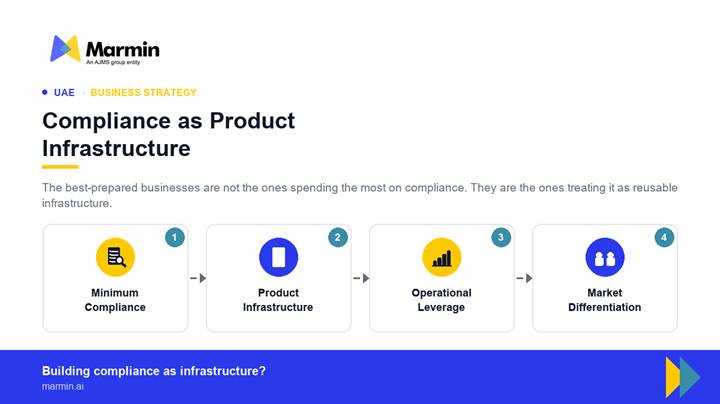
The difference between minimum compliance and compliance built as reusable infrastructure. Original graphic, Marmin brand style.
What treating compliance as infrastructure actually looks like
The distinction is not primarily about spending more money. Both approaches involve selecting an accredited provider and building a working connection. The difference is in what gets specified before go-live: does the implementation handle reconciliation automatically, not just submission? Does it scale without a redesign as transaction volume grows? Does the provider relationship extend to other markets a business might enter, including Saudi Arabia or increasingly Oman? None of these questions are required to pass FTA validation, but each one determines whether the resulting system remains genuinely useful two or three years after go-live.
There is also a data quality dividend that compounds beyond compliance itself. A business that invests in clean, complete invoice data to satisfy the mandate’s 51 mandatory fields ends up with better underlying data for its own financial reporting, forecasting, and customer analysis, benefits that have nothing directly to do with tax compliance but flow naturally from doing the compliance work properly.
The external signal this creates
Compliance infrastructure built well is increasingly visible to people outside a business’s own finance function: investors assessing operational maturity, enterprise counterparties running vendor due diligence, and auditors evaluating financial controls. A business whose e-invoicing, reconciliation, and reporting systems are demonstrably well-integrated signals something concrete about its operational discipline, in a way that a business scrambling to patch a minimum-viable system after a near-miss compliance issue does not.
This visibility tends to matter most at exactly the moments a business can least afford to be caught unprepared: fundraising due diligence, a major enterprise sales cycle, or a strategic partnership negotiation. In each of these scenarios, a counterparty’s assessment of operational maturity increasingly includes a look at how cleanly financial and compliance systems function, and businesses that built for durability rather than the minimum find this scrutiny straightforward to satisfy rather than stressful to prepare for on short notice.
Practical recommendations
- When scoping your e-invoicing implementation, explicitly evaluate whether the build addresses reconciliation and data quality, not just invoice submission and validation.
- Assess whether your chosen platform can scale with transaction volume growth without requiring a rebuild, particularly given how much continuous e-invoicing changes reconciliation demands.
- If your business has any regional ambitions, factor multi-market reuse into your provider selection now, since retrofitting that later costs more than building for it initially.
- Frame the mandate internally as an infrastructure investment opportunity, not solely a compliance cost, when communicating the project’s scope and budget to leadership.
What organizations should do now
The regulatory deadline itself is fixed and cannot be negotiated. Whether the system built to meet it is designed to last is a genuine choice, made during vendor selection and initial scoping, not after go-live. Businesses making that choice deliberately now will find themselves meaningfully better positioned in two years than those who treated the mandate purely as a box to check.
The Marmin perspective
Marmin’s platform is built around reconciliation, ERP-agnostic integration, and multi-jurisdiction operation as core features rather than add-ons layered onto a minimum compliance connection. Marmin, an AJMS Group company and UAE Ministry of Finance approved e-invoicing service provider, serves this infrastructure-first approach across its confirmed markets, a relevant consideration for UAE business leaders deciding which frame will guide their own e-invoicing build.
This piece reflects publicly available regulatory information as of August 2026 and is provided for general informational purposes only. It does not constitute legal, tax, or compliance advice. Organizations should confirm current requirements directly with the relevant regulator before making implementation decisions.

Leave a Reply