
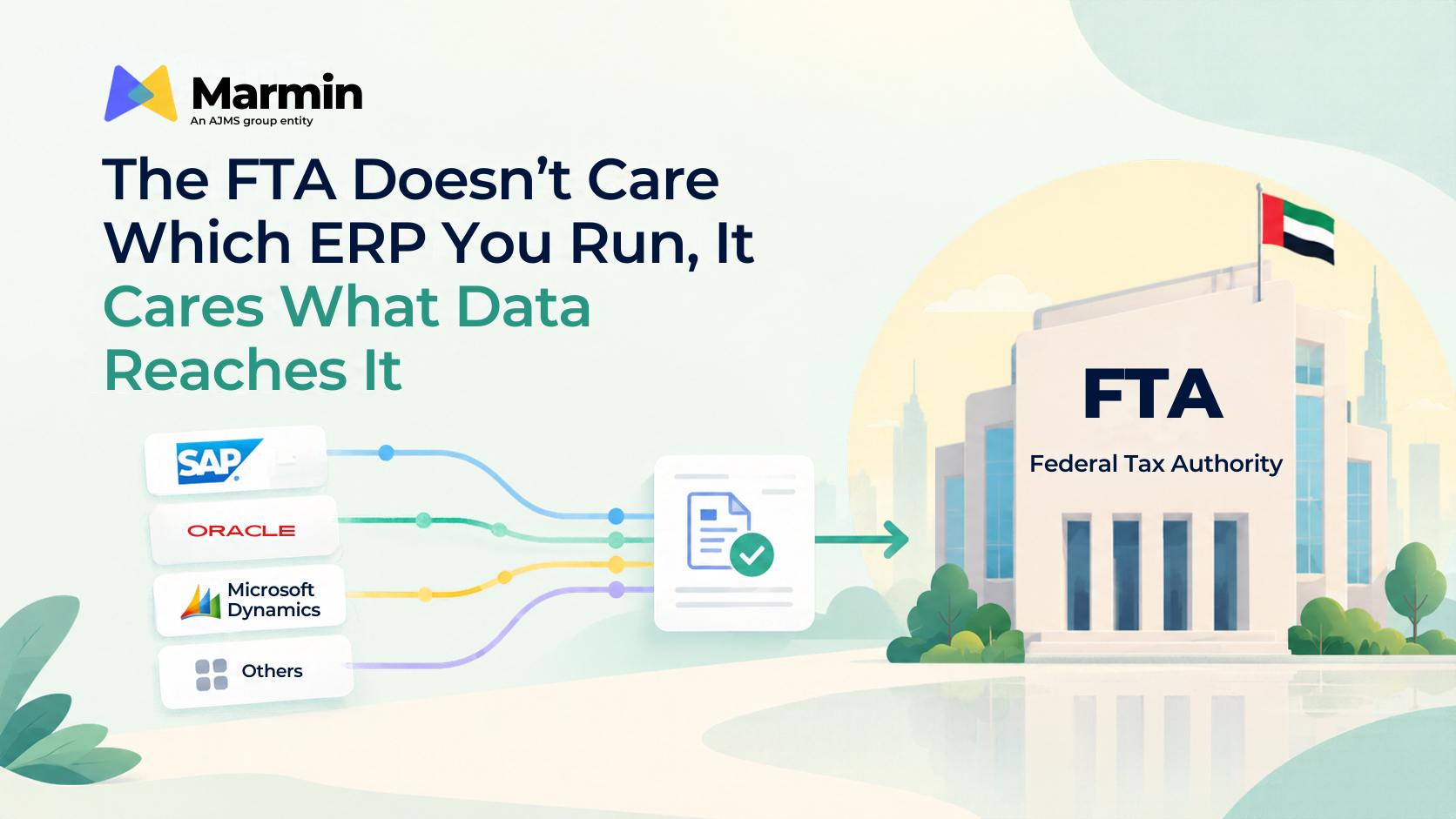
Businesses spend enormous energy worrying about ERP compatibility. The actual requirement according to FTA is narrower, and more specific, than that worry usually accounts for.
A recurring concern among CIOs preparing for UAE e-invoicing is whether their specific ERP, whether a major platform like SAP or Oracle, or a smaller regional system, is compatible with the mandate. This concern, while understandable, is somewhat misdirected. The FTA requirement is not about which ERP a business runs. It is about whether the correct data, formatted correctly, reaches an accredited service provider for validation and transmission. Almost any ERP can satisfy this requirement, given the right integration approach.
What actually determines readiness
The UAE Electronic Invoicing Guidelines and the accompanying Mandatory Fields document define 51 required fields aligned to the PINT AE specification. These fields need to be populated correctly in every outgoing invoice, regardless of which system generates that invoice. The real question for any CIO is not whether the ERP itself is compatible in some abstract sense, but whether the business’s current invoicing process reliably captures all 51 required fields with accurate data.
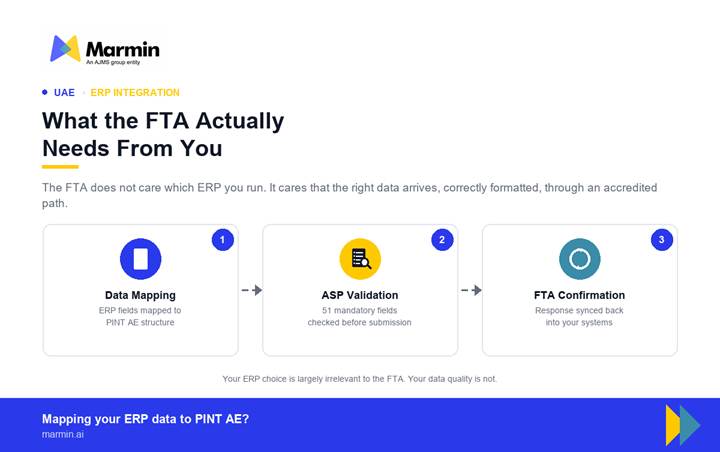
What the FTA actually requires, independent of ERP platform. Original graphic, Marmin brand style.
Where the real gaps usually are: FTA
In practice, ERP compatibility concerns often mask a different, more mundane problem: incomplete or inconsistent data capture in current invoicing workflows. A business might discover, while mapping its invoice data against the 51 mandatory fields, that certain fields are populated inconsistently across different sales channels, or that a field the specification requires is not currently captured at all in the standard invoicing workflow. This is a data governance issue, not an ERP compatibility issue, and it exists regardless of which ERP the business runs.
This distinction matters because it changes where the implementation effort should actually go. Time spent researching ERP compatibility in the abstract is often less valuable than time spent auditing actual invoice data quality against the specific field requirements, since the latter is where genuine gaps tend to surface.
Deployment method as the real integration decision
Once data quality is addressed, the remaining decision is deployment method: full API integration, bulk upload via spreadsheet, or SFTP-based file transfer, among other options most accredited service providers support. This choice depends far more on internal engineering capacity and existing system architecture than on the ERP platform itself. A business with strong internal development resources might prefer API integration for tighter automation. A business without that capacity can achieve full compliance through bulk upload, without needing any custom ERP integration at all.
It is worth revisiting this decision even after initial go-live, rather than treating it as fixed once made. A business that starts with bulk upload for speed of implementation may find, as transaction volume grows, that migrating to a more automated API integration reduces manual effort meaningfully. Providers that support multiple deployment methods within the same underlying platform make this kind of migration considerably easier than switching providers entirely once the original deployment choice no longer fits the business’s scale.
Practical recommendations
- Audit your current invoice data against the 51 mandatory fields defined in the UAE’s Mandatory Fields document, independent of any ERP compatibility research.
- Identify which fields, if any, are inconsistently populated across different sales channels or business units, since this is the most common source of go-live delays.
- Choose your deployment method, API, bulk upload, or SFTP, based on internal engineering capacity rather than defaulting to the most technically sophisticated option.
- Involve whoever owns invoice data quality in your organization early in the project, since this is frequently a different person or team than whoever owns the ERP relationship.
What organizations should do now– FTA
CIOs spending significant time evaluating ERP compatibility in the abstract should redirect that effort toward a concrete data audit against the actual field requirements. This reframing tends to surface the real implementation gaps faster and focuses the project on the work that actually determines readiness, rather than a question that, for the vast majority of modern ERPs, has a straightforward answer.
The Marmin perspective
Marmin’s platform is built with ERP-agnostic connectors supporting SAP, Oracle, Microsoft Dynamics, Xero, Zoho, and Tally, alongside deployment options spanning WebApp, API, SFTP, and CSV upload, reflecting exactly this reality that ERP compatibility is rarely the actual constraint. Marmin, an AJMS Global company and certified Peppol Access Point, is one option for CIOs who have completed a data quality audit and are ready to select a deployment approach that fits their existing systems.
This piece reflects publicly available regulatory information as of August 2026 and is provided for general informational purposes only. It does not constitute legal, tax, or compliance advice. Organizations should confirm current requirements directly with the relevant regulator before making implementation decisions.

Leave a Reply