
In UAE e-invoicing model, the invoice is a structured XML document. The Ministry of Finance’s Electronic Invoicing Guidelines state that the system will not use a QR code or barcode, so the XML is the invoice. That makes every system that receives, stores or renders those files a place where an XML parser runs.
XML parsers have a long record of being tricked into reading local files, calling internal services or consuming all available memory. None of this is specific to e-invoicing, but e-invoicing concentrates valuable financial data behind exactly this kind of parser. This article sets out what the risks look like in a finance environment, what OWASP recommends, and how to test your own set-up before the 1 January 2027 go-live for the largest taxpayers.
Who parses what in the five-corner model
In the UAE model, the supplier’s Accredited Service Provider converts the data into the UAE standard XML, validates it and sends it across the Peppol network, while the buyer’s provider validates it again on receipt and delivers it to the buyer. Your own systems also touch XML: the connector that imports invoices into the ERP, the accounts payable automation tool, the archive that indexes documents and the viewer that renders a human-readable copy.
Provider validation is a strong first line of defence, but it is not a reason to leave your own parsers soft. The Ministry’s Guidelines leave agreement on business-specific data security requirements to the taxpayer and its provider, and nothing in them says the provider’s checks replace your own.
Four ways an invoice file can attack a parser
| Risk | What it looks like | Why it matters in finance |
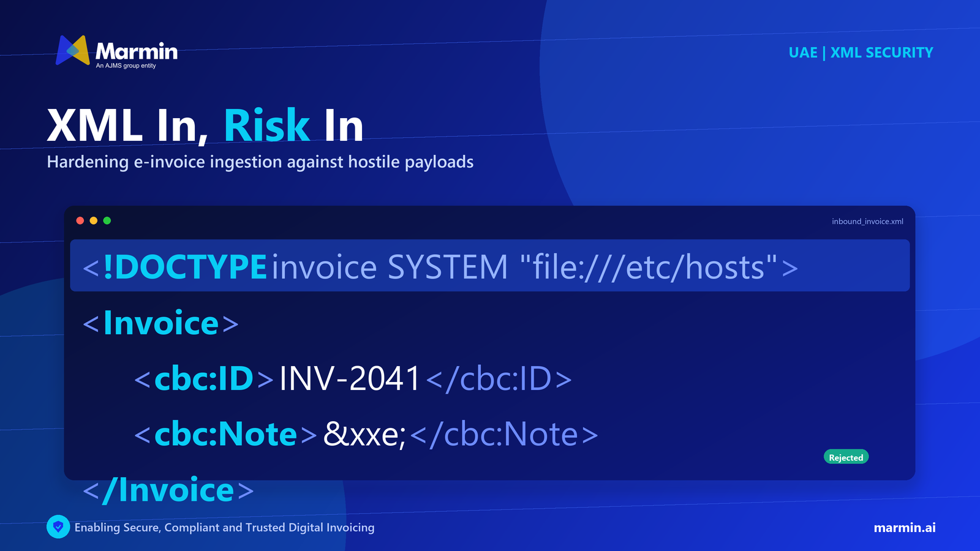
| External entity reference (XXE) | A document type declaration that points to a local file or an internal address | A parser may read a local file or contact an internal system and leak the result into a field |
| Entity expansion | Nested entity definitions that expand into a huge amount of text | Memory and CPU exhaustion that stops invoice processing at month end |
| Jumbo payloads | Extremely deep, wide or large documents | Queues back up, and genuine invoices miss their issuance window |
| Schema poisoning | A document that names a remote schema to validate against | Validation is performed against the attacker’s rules instead of yours |
What OWASP recommends
OWASP’s XML External Entity Prevention Cheat Sheet is direct: disable document type definitions wherever possible, and where a parser supports it, reject any document that contains a DOCTYPE declaration. If definitions cannot be avoided, turn off external entity resolution and external DTD loading and limit entity expansion. The sheet adds that restrictions should also apply during schema validation and XSLT processing, and that processing must stop if a required security setting fails, rather than catching the exception and carrying on.
OWASP’s XML Security Cheat Sheet adds three points that suit invoices well. Define each document with a precise XML Schema rather than a DTD, using tight data types and bounded repetition. Validate against a local, known-good copy of the schema, not one named in the document. Reject malformed input rather than relying on recovery modes. The sheet recommends replacing unbounded repetition with a maximum but gives no numeric limits, so size and depth limits should come from your own transaction profile. In the OWASP Top 10:2025, XXE falls under A02, Security Misconfiguration, as CWE-611.
A scenario: the invoice that reads a file
A distributor in Dubai runs an accounts payable tool that imports supplier XML through a connector. During a test, a security consultant submits a file that declares an external entity pointing to a local configuration file and places the entity in the free-text note field. If the parser resolves it, the contents of the file appear in the invoice record that finance staff can view. The fix is not clever. It is a parser setting that rejects DOCTYPE declarations, checked by a regression test that runs with every software update.
A test plan you can run this month
- Build four test documents: one with a DOCTYPE and external entity, one with nested entity expansion, one with extreme nesting depth, and one that is simply very large.
- Send each through every path that accepts XML: ERP import, accounts payable automation, bulk upload and archive indexing.
- Confirm each is rejected quickly, with no outbound connection and no memory spike, and that a clear alert is raised.
- Repeat after every upgrade of the parser, the connector or the runtime.
Security implications and recommendations
- Harden every parser, not only the one in your integration layer. Archive and viewer components are often forgotten.
- Use local schemas and size limits informed by your largest legitimate invoice plus a margin.
- Block outbound connections from hosts that parse untrusted XML, so that even a missed setting cannot reach internal services.
- Log rejections and treat repeated rejections from one source as an incident signal.
- Remember the status of this advice. No UAE rule prescribes parser settings for taxpayers. These are recommended practices drawn from OWASP. The mandatory security criteria in Ministerial Decision 168 of 2026 (multifactor authentication, encryption, security monitoring and ISO/IEC 27001 certification for the product) apply to Accredited Service Providers, not to taxpayers generally.
Conclusion
An XML invoice is only as safe as the parser that reads it. The controls are well known, inexpensive and testable, which makes them an ideal item for a pre-go-live security checklist.
Treat provider validation as one layer, add your own, and prove both work with hostile test files rather than assuming they do.
Marmin AI Software Design LLC appears on the UAE Ministry of Finance’s published list of Accredited Service Providers. If you would like an independent look at how your e-invoicing connections handle security, speak to Marmin’s UAE team about a technical review.
SOURCES AND REFERENCES
- UAE Electronic Invoicing Guidelines, Version 2.0 (26 October 2026). UAE Ministry of Finance. https://mof.gov.ae/wp-content/uploads/2026/10/UAE-Electronic-Invoicing-Guidelines_En.pdf
- Ministerial Decision No. 168 of 2026 on Eligibility Criteria and Accreditation Procedure for Service Providers. UAE Ministry of Finance, effective 1 October 2026. https://mof.gov.ae/wp-content/uploads/2026/10/Ministerial-Decision-No-168-of-2026-on-Eligibility-criteria-and-Accreditation-Procedure-EN-FINAL.pdf
- United Arab Emirates electronic document specifications (PINT AE Billing, Self-Billing, Tax Data Document). OpenPeppol, maintained by the UAE Peppol Authority (release of 29 July 2026). https://docs.peppol.eu/poac/ae/
- XML External Entity Prevention Cheat Sheet. OWASP Cheat Sheet Series (accessed 10 November 2026). https://cheatsheetseries.owasp.org/cheatsheets/XML_External_Entity_Prevention_Cheat_Sheet.html
- XML Security Cheat Sheet. OWASP Cheat Sheet Series (accessed 10 November 2026). https://cheatsheetseries.owasp.org/cheatsheets/XML_Security_Cheat_Sheet.html
- REST Security Cheat Sheet. OWASP Cheat Sheet Series (accessed 10 November 2026). https://cheatsheetseries.owasp.org/cheatsheets/REST_Security_Cheat_Sheet.html
- OWASP Top 10:2025. OWASP Top 10 Team. https://top10.owasp.org/2025
Regulatory content reflects UAE Ministry of Finance, Federal Tax Authority and OpenPeppol documents as of 10 November 2026. Where this piece describes the PDPL, the cybercrime law or sector rules, it relies on secondary commentary because the official text could not be retrieved; please have UAE counsel confirm before external publication.

Leave a Reply