
RegTech in Oman is not arriving as a single new tool. It is arriving as pressure to connect four functions businesses have always kept separate.
RegTech, as a category, tends to get discussed as a set of individual tools: a screening product here, a reconciliation tool there, a reporting dashboard somewhere else. In Oman, something more structural is happening beneath that tool-by-tool framing. Fawtara, the PDPL’s move into active enforcement, and Oman’s UBO register requirements are all landing on finance and compliance teams within roughly the same eighteen-month window, and the businesses handling that well are not buying more individual tools. They are connecting the ones they already have.
Four functions that have always been separate
E-invoicing, reconciliation, sanctions and UBO screening, and regulatory reporting have historically been managed as four distinct functions in most Omani finance teams, often with different owners, different systems, and different review cadences. This separation was manageable when each function operated on its own independent timeline. It becomes harder to sustain once e-invoicing under Fawtara moves to a continuous, transaction-level cadence, because a reconciliation process, a screening process, or a reporting process still running on a slower, periodic cadence increasingly lags behind the pace the business’s own invoicing has adopted.
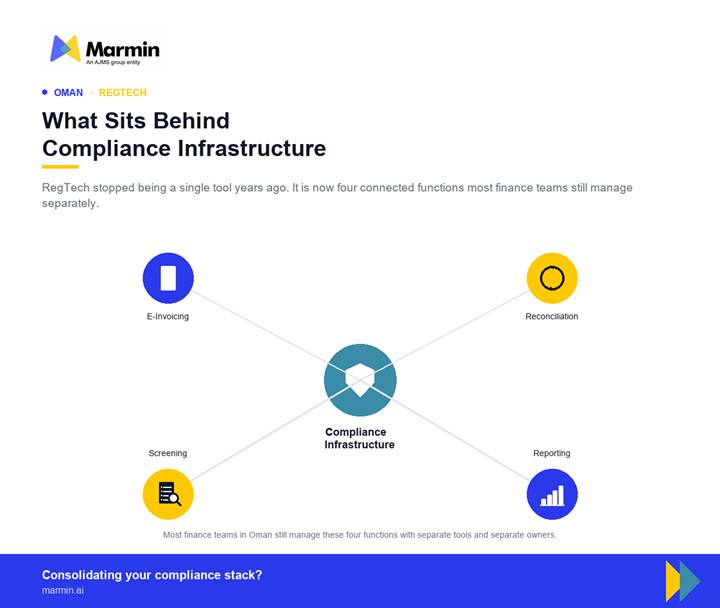
Four compliance functions most finance teams still manage separately. Original graphic, Marmin brand style.
Why this counts as a RegTech shift, not just a Fawtara project
It would be a mistake to read this purely as a Fawtara compliance exercise, because the pressure toward connected infrastructure is coming from multiple directions simultaneously. Oman’s PDPL transition period ended in February 2026, meaning MTCIT is now in active supervisory enforcement of data protection obligations that touch invoice and customer data alike. The UBO register requirement under Ministerial Decision No. 245/2025 expects ownership records to stay current, not just accurate at filing. Each of these, on its own, would be a modest compliance update. Landing together, they create genuine pressure to treat compliance as shared infrastructure rather than separate departmental responsibilities.
What connected infrastructure actually looks like in practice
This does not necessarily mean replacing every existing tool with a single platform. It means ensuring the systems a business already uses for e-invoicing, reconciliation, screening, and reporting can share data and stay synchronized, so that a change caught in one function, a validation failure, a screening flag, a reconciliation exception, is visible to the others rather than trapped in a departmental silo. Businesses that achieve this tend to spend less on compliance overall, not more, because they stop duplicating detection and correction work across systems that were never designed to talk to each other.
A useful practical test is to trace a single invoice from creation through to its appearance in a VAT return and ask how many separate systems, and how many manual handoffs between people, it passes through along the way. In most Omani finance teams today, that trace reveals more disconnected steps than expected. Reducing that number, even gradually and without a single large platform purchase, is what connected compliance infrastructure actually looks like in practice, and it is achievable incrementally rather than requiring a wholesale system replacement.
Practical recommendations
- Map which of the four functions, e-invoicing, reconciliation, screening, and reporting, currently share data automatically and which require manual handoffs between teams.
- Prioritize closing the manual handoffs that touch the most time-sensitive function first, which for most businesses is now e-invoicing given Fawtara’s continuous cadence.
- When evaluating any new compliance tool, ask specifically how it integrates with the other three functions, not just how well it performs its own core task.
- Treat this as an ongoing infrastructure investment rather than a one-time project tied to any single deadline, since new regulatory requirements will continue to test how well these functions stay connected.
What organizations should do now
The businesses best positioned for what comes after Fawtara’s mandatory phases are not necessarily the ones that spent the most on compliance technology. They are the ones that used this period to connect functions that had always operated separately, so that the next regulatory change, whatever it turns out to be, lands on infrastructure built to absorb it rather than four disconnected systems each needing their own update.
The Marmin perspective
Marmin’s platform combines e-invoicing, automatic VAT and tax reconciliation, and multi-country dashboards as connected capabilities rather than separate purchases, reflecting exactly the kind of infrastructure consolidation this shift calls for. Marmin, an AJMS Group company and UAE Ministry of Finance fully approved e-invoicing asp in oman, is one example of this connected approach, relevant for Omani finance leaders assessing how their own compliance functions currently fit, or fail to fit, together.
This piece reflects publicly available regulatory information as of August 2026 and is provided for general informational purposes only. It does not constitute legal, tax, or compliance advice. Organizations should confirm current requirements directly with the relevant regulator before making implementation decisions.

Leave a Reply