

Understanding how UAE e-invoicing actually moves data, and why that matters for architecture decisions, not just compliance ones.
When UAE finance and IT teams discuss e-invoicing, the conversation tends to center on dates: the 1 July 2026 voluntary phase. The 1 January 2027 mandatory go-live for large businesses. Less discussed, and arguably more consequential for how systems get architected, is the model itself: Peppol five-corner structure. And what it means that an invoice generated inside your ERP now travels through several external systems before it reaches its recipient.
How the Peppol model actually works
The UAE’s e-invoicing framework, overseen by the Ministry of Finance with the Federal Tax Authority (FTA) as the receiving body, runs on the Peppol five-corner model. An invoice originates with the supplier, passes to the supplier’s Accredited Service Provider (ASP), which validates it against PINT AE formatting rules, travels across the UAE Peppol network itself, a routing layer rather than any single company’s infrastructure, to the buyer’s ASP, and finally reaches the buyer. Both ASPs simultaneously report tax-relevant data to the FTA: the parallel reporting channel that makes this a five-corner model rather than the original four-corner Peppol design used elsewhere.
For a CIO, the architectural implication is straightforward but easy to underweight: invoice data leaves your direct control earlier, and more completely, than in a traditional point-to-point integration. You are not sending a file to one counterparty’s system. You are handing data to a validating intermediary, which hands it to a network, which hands it to another intermediary, which hands it to the counterparty, while a fourth party, the FTA, receives a parallel copy. Each handoff is a point where formatting can fail, latency can accumulate, or, from a security standpoint, data can be exposed if any link in that chain isn’t held to the same standard as the others.
Why the specification detail matters
This isn’t optional interpretation. The UAE Electronic Invoicing Guidelines (version 1.1, published June 2026) and the Mandatory Fields document (version 1.0, February 2026) define 51 required fields aligned to PINT AE. Getting validation logic right the first time matters more here than in a typical B2B integration, because invoices failing ASP validation don’t simply bounce back for a quiet correction. Given the requirement to issue invoices within 14 days of the taxable event, repeated validation failures risk pushing a transaction outside its compliance window entirely.
Scope also matters here. B2C transactions remain exempt from the mandate until further notice, and certain financial-services and airline transactions are excluded, which means most ERPs will need to route invoices differently depending on transaction type rather than pushing every outgoing invoice through the same Peppol pathway. For businesses with mixed B2B and B2C revenue, that routing logic is itself a non-trivial build, one that’s easy to underestimate if e-invoicing is scoped as a single integration project rather than a set of conditional data flows.
The business case beyond compliance
It’s worth separating two different projects that often get bundled under the same deadline: becoming compliant, and becoming operationally efficient because of the same infrastructure. A properly architected Peppol connection, with clean validation, monitored exception handling, and reconciliation built to match invoice volume rather than a monthly batch, tends to reduce the manual reconciliation load that has historically absorbed finance team time regardless of the e-invoicing mandate. Businesses that treat the mandate purely as a compliance cost tend to build the minimum viable connection; those that treat it as a systems upgrade tend to capture that secondary efficiency gain as well.
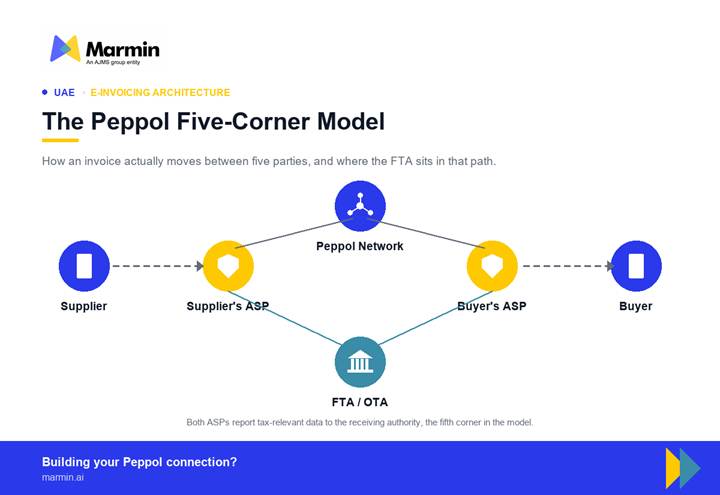
The Peppol five-corner model underlying UAE e-invoicing. Both ASPs report to the FTA in parallel with the buyer-supplier exchange. Original graphic, Marmin brand style.
Practical recommendations
- Treat ASP selection as an infrastructure decision, not a vendor form. Ask specifically how the provider handles validation error resolution, uptime commitments, and behavior during Peppol network disruptions, not just accreditation status.
- Map exactly where your invoice data resides at each stage of the five-corner journey, and confirm each stage meets your organization’s own security and data-handling expectations, not only the ASP’s minimum regulatory bar.
- Build monitoring for validation failures as a first-class operational metric, not an exception queue reviewed once a week.
- If you operate across multiple GCC markets, evaluate whether your ASP’s Peppol experience extends beyond the UAE. The same five-corner logic, with local variations, is now spreading to Oman’s Fawtara programme and other regional mandates.
What organizations should do now
The ASP appointment deadline for large businesses (revenue at or above AED 50 million) now sits at 30 October 2026, extended from the original 31 July 2026 date via Ministerial Resolution No. 66 of 2026. Mandatory go-live, however, is unchanged at 1 January 2027. The extension buys planning time, not architecture time. The systems decisions described above take as long to get right regardless of when the appointment deadline falls.
The Marmin perspective
Organizations preparing for mandatory e-invoicing increasingly need a platform layer that treats Peppol connectivity as core infrastructure rather than a bolted-on compliance feature. Marmin, an AJMS Group company, is a UAE Ministry of Finance pre-approved e-invoicing service provider and a certified Peppol Access Point, operating with 100% UAE data residency for the invoice data it processes, a relevant reference point for CIOs evaluating how much control they retain, and where, across the five-corner journey.
This piece reflects publicly available regulatory information as of August 2026 and is provided for general informational purposes only. It does not constitute legal, tax, or compliance advice. Organizations should confirm current requirements directly with the relevant regulator before making implementation decisions.

Leave a Reply