
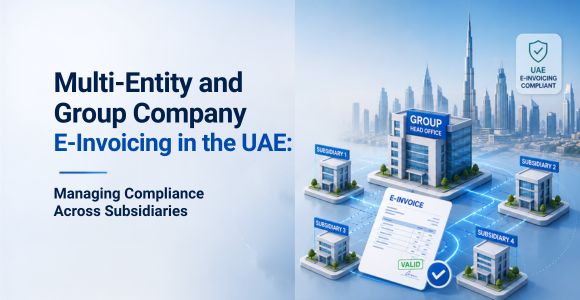
A single-entity business has a straightforward path to e-invoicing compliance: appoint an ASP, connect the ERP, validate, go live. For UAE e-invoicing group companies operating multiple legal entities, the picture is more complex. Each entity carries its own compliance obligation, its own TIN, and potentially its own deadline.
This post addresses the practical questions of multi-entity e-invoicing UAE groups face when planning e-invoicing across a multi-entity structure: whether to use one ASP or multiple, how to handle intercompany invoices, how TINs work across entities, and whether to centralise or decentralise the implementation.
Managing e-invoicing across multiple entities?
Marmin supports multi-entity onboarding with pre-built ERP connectors.
Each Legal Entity Is a Separate Compliance Obligation
The UAE e-invoicing mandate applies at the legal entity level, not the group level. Each entity that falls within the scope of Ministerial Decision No. 243 of 2025 must independently comply with the requirement to appoint an ASP, implement the e-invoicing system, and transmit invoices through the Peppol network.
This means a group with five UAE legal entities has five separate compliance obligations. If three of those entities have annual revenue above AED 50 million, those three fall into Phase 1 with an ASP appointment deadline of 30 October 2026 and a go-live date of 1 January 2027. The remaining two may fall into Phase 2 with a 1 July 2027 timeline. The group cannot treat its compliance as a single project with a single deadline.
TIN Management Across Entities
Managing TIN e-invoicing multiple entities is one of the core data governance challenges for UAE groups. Under the UAE e-invoicing framework, each legal entity is identified by its Tax Identification Number (TIN), which replaces the Tax Registration Number (TRN) as the primary identifier in the e-invoicing system. Every Electronic Tax Invoice must carry the correct issuing and receiving TIN.
For group companies, TIN management becomes a data governance exercise. Each entity’s TIN must be correctly mapped in the ERP or accounting system, and invoices must be generated under the correct entity. Groups operating shared service centres where one team processes invoices for multiple entities must ensure that the system routes each invoice to the correct TIN and the correct ASP connection.
Errors in TIN assignment, such as issuing an invoice under the wrong entity’s TIN, will create mismatches in the FTA’s records and may affect input VAT recovery for the recipient.
One ASP or Multiple? The Centralised vs. Decentralised Decision
Group companies face a strategic choice between centralised e-invoicing UAE (one ASP for all entities) or a decentralised approach where each entity appoints its own. Both approaches are permitted under the mandate, and the right choice depends on the group’s operational structure.
Single ASP for All Entities
Appointing one ASP across the group simplifies vendor management, consolidates the commercial relationship, and provides a single reporting dashboard across all entities. This approach works well for groups with a centralised finance or shared services function, a common ERP platform across entities, and a preference for unified reporting.
The key consideration is whether the chosen ASP can handle the onboarding of multiple entities within the required timeline. Each entity’s integration is a separate workstream, even if the ASP is the same, because each entity has its own TIN, its own ERP configuration, and potentially its own data mapping requirements.
Multiple ASPs Across Entities
Some groups may find that different entities are better served by different ASPs, particularly where entities operate on different ERP platforms, in different industries, or with different invoice volumes and complexity. A manufacturing subsidiary on SAP and a services subsidiary on Microsoft Dynamics may have different integration requirements that are best met by ASPs with specific ERP expertise.
The trade-off is management complexity. Multiple ASPs mean multiple contracts, multiple reporting interfaces, and potentially different validation standards. Groups choosing this approach should designate a central coordinator, typically within the shared services or group finance function, to maintain visibility across all entities.
Intercompany Invoices Under E-Invoicing
Intercompany e-invoicing UAE groups must implement the same rules as any B2B transaction – no exemption exists for intra-group billing. Transfer pricing, management fees, shared service charges, and intra-group supply of goods all generate invoices that must be transmitted as Electronic Tax Invoices through the Peppol network. If both entities are within the mandatory scope, the intercompany invoice must be transmitted as an Electronic Tax Invoice through the Peppol network, with the issuing entity’s TIN and the receiving entity’s TIN, validated in PINT AE format, and reported to the FTA. There is no exemption for intra-group transactions.
This has practical implications for groups that currently process intercompany invoices through simplified or manual workflows. Every intercompany invoice must now meet the same validation standards as an external invoice. Groups should review their intercompany billing processes early in the implementation to identify any invoices that may not currently meet PINT AE requirements.
Shared Service Centres and Centralised Invoice Processing
Many UAE group companies operate shared service centres (SSCs) where a central team handles accounts payable and accounts receivable for multiple entities. Under e-invoicing, the SSC model remains viable, but requires careful configuration.
The SSC must be able to generate and transmit invoices on behalf of each entity, under that entity’s TIN and through that entity’s ASP connection. The ERP or invoice processing system must support multi-entity workflows where a single user or team can switch between entities without data leakage between TINs.
The ASP platform must also support this model. The ASP needs to maintain separate entity profiles, each with its own TIN, validation rules, and reporting feeds. When evaluating ASPs, groups with SSC structures should specifically test the multi-entity capability during the onboarding process.
Implementation Sequencing for Group Companies
Groups should not attempt to onboard all entities simultaneously unless the timeline demands it. A phased approach, starting with the highest-volume or most complex entity, allows the implementation team to develop playbooks and resolve integration issues before rolling out to subsequent entities.
A practical sequencing approach for a group with multiple Phase 1 entities:
| Phase | Timeline | Activity |
| Pilot entity | July to September 2026 | Onboard the first entity during the voluntary phase. Test full cycle from ERP to Peppol transmission. |
| Second wave | September to October 2026 | Apply lessons from the pilot to onboard the next two to three entities. |
| Remaining entities | October to December 2026 | Complete onboarding for all Phase 1 entities before the 1 January 2027 go-live. |
| Phase 2 entities | Q1 to Q2 2027 | Onboard entities below AED 50 million revenue, using the established playbook. |
This approach compresses risk into the pilot phase, where the voluntary penalty exemption provides a safety net, and expands capacity as the team gains confidence.
How Marmin AI Supports Multi-Entity Onboarding
Marmin AI is a UAE Ministry of Finance Accredited Service Provider and an AJMS Group company. Marmin’s platform supports multi-entity configurations, allowing group companies to onboard multiple legal entities under a single ASP relationship while maintaining separate TIN profiles, validation rules, and reporting feeds for each entity.
With pre-built ERP connectors for SAP, Oracle, Microsoft Dynamics, and other platforms, Marmin can accommodate groups where different entities operate on different systems. The platform’s 180+ real-time validation checks apply at the entity level, ensuring each invoice is validated against the correct TIN and compliance requirements.
Discuss your multi-entity e-invoicing implementation.
Key Takeaways
Group company e-invoicing is not one project. It is multiple parallel compliance obligations, each tied to a specific legal entity, its TIN, its ERP, and its revenue-based timeline. The groups that execute well will be the ones that make three decisions early: single ASP or multiple, centralised or decentralised implementation, and which entity goes first. Every other decision flows from those three.
