
Connecting to a counterparty through Fawtara’s Peppol network in oman happens automatically once onboarding is complete. The risk review that should accompany it often does not.
Internal audit teams have long treated vendor onboarding as a discrete, one-time risk review: assess a new counterparty, approve or reject the relationship, and revisit only if something changes materially. Fawtara’s Peppol network quietly complicates this model, because once a counterparty is onboarded to the network, invoice exchange with them becomes continuous and largely automated. The one-time review that approved the relationship rarely gets revisited at the pace the relationship itself now operates.
Why network connections are different from traditional vendor relationships
A traditional vendor relationship involves periodic transactions, each of which can, in principle, be reviewed individually if something looks unusual. A Peppol network connection under Fawtara is structurally different: once established, invoices flow continuously through validated, automated channels, with the accredited service providers on both sides handling formatting and transmission. This is precisely the efficiency the network is designed to deliver, and it is also exactly why the initial onboarding decision carries more weight than it might for a traditional vendor relationship. There are fewer natural checkpoints afterward where risk gets reassessed.
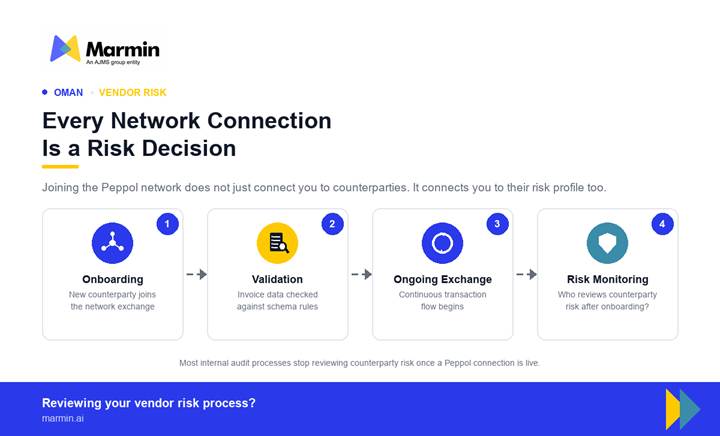
Where counterparty risk review typically stops after Peppol onboarding. Original graphic, Marmin brand style.
The gap between validation and risk review
It is worth being precise about what Peppol’s validation layer actually checks, because it is easy to conflate with risk assessment. Validation confirms that submitted invoice data meets the required schema and business rules. It says nothing about the counterparty’s financial stability, ownership structure, sanctions exposure, or broader business risk profile. A counterparty can pass every technical validation check indefinitely while the underlying business relationship carries risk that nobody in the organization is actively monitoring, because the validation layer was never designed to catch that.
Where this connects to Oman’s broader compliance landscape
This gap becomes more consequential set against Oman’s UBO register requirements under Ministerial Decision No. 245/2025, which expects ownership information to stay current, and the broader AML and CFT framework overseen by the Central Bank of Oman and other sector regulators. A counterparty whose ownership or risk profile changes after Peppol onboarding will not surface that change through the invoicing exchange itself. It surfaces only if a business has a separate process actively watching for it.
There is also a network topology dimension worth considering. Because Peppol connects businesses through shared accredited service providers rather than direct point-to-point links, a business’s risk exposure is not limited to its own direct counterparties. It extends, at least indirectly, to how well the broader network of ASPs and connected businesses maintains its own standards. This is not a reason to distrust the network, since the same is true of any shared financial infrastructure, including the banking system itself, but it is a reason internal audit functions should understand the network’s structure rather than treating it as a simple upgrade to how invoices are exchanged.
Practical recommendations
- Extend vendor risk review processes explicitly to cover Peppol network onboarding, rather than treating network connection as a purely technical, IT-owned step.
- Establish a periodic re-review cadence for counterparties connected via the network, distinct from the one-time onboarding assessment, given how few natural checkpoints exist afterward.
- Coordinate between internal audit and compliance teams so that UBO register updates and sanctions screening results feed into ongoing counterparty risk review for network-connected vendors specifically.
- Document network onboarding decisions with the same rigor applied to other vendor risk decisions, since the automated nature of ongoing exchange does not reduce the stakes of the initial decision.
What organizations should do now
As Fawtara’s mandatory phases bring more of Oman’s business network onto Peppol, the number of counterparty connections most businesses maintain will grow, and with it, the aggregate risk surface that internal audit and compliance functions are responsible for monitoring. Building the review process now, while the network is still relatively young, is considerably easier than retrofitting it once dozens or hundreds of network connections are already live and unmonitored.
The Marmin perspective
This piece has focused on a structural gap in how vendor risk processes typically handle automated network connections, a gap that exists regardless of which accredited service provider a business uses to connect to Fawtara. Marmin, an AJMS Group company and certified Peppol Access Point, operates within this same network architecture, and understanding the gap described here is relevant context for any business, using any provider, building its internal audit process around Peppol connectivity.
This piece reflects publicly available regulatory information as of August 2026 and is provided for general informational purposes only. It does not constitute legal, tax, or compliance advice. Organizations should confirm current requirements directly with the relevant regulator before making implementation decisions.

Leave a Reply