
AML screening cadence was designed around how fast money used to move. Both payments and invoicing now move faster than most screening cycles account for.
Periodic AML and UBO screening cadences, typically quarterly or monthly reviews, were designed at a time when the underlying transaction environment moved at a comparable pace. Payments cleared over days. Invoicing was largely a batch process. A quarterly screening cycle was a reasonable match for that speed. Both of those underlying assumptions have shifted meaningfully in the UAE, and the screening cadence many compliance functions still run has not shifted with them.
What actually changed
Real-time and near-real-time payment infrastructure has become increasingly standard, meaning funds can move between accounts in seconds rather than days. Separately, and just as significantly, UAE e-invoicing mandate moves invoice data continuously, validated and confirmed by the FTA as transactions occur, rather than accumulated in periodic batches the way most legacy invoicing processes operated. Both shifts mean the transaction environment compliance teams are screening against now moves considerably faster than the review cycle designed to monitor it.
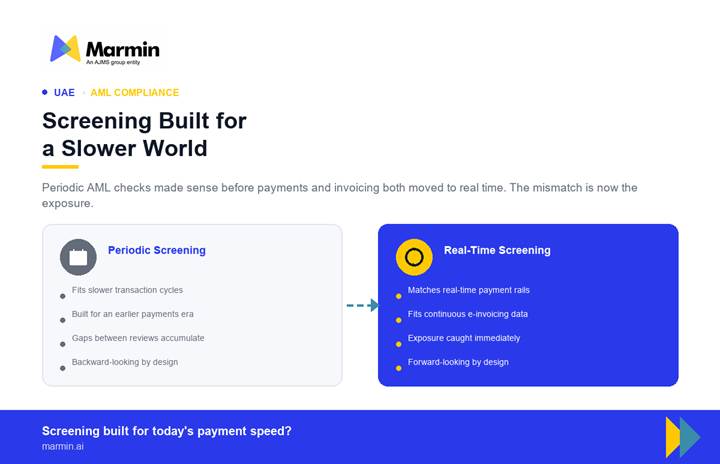
Why periodic screening no longer matches the pace of real-time payments and continuous invoicing. Original graphic, Marmin brand style.
Why the current AML law reinforces this shift
Federal Decree-Law No. 10 of 2025, effective 14 October 2025, broadened the UAE’s AML/CFT framework, including how predicate crimes are defined and how mental-state thresholds for enforcement are assessed, with corporate penalties reaching up to AED 100 million. Alongside this, the Central Bank of the UAE issued an updated AML/CFT/CPF guidance package for licensed financial institutions in April 2026, reinforcing a risk-based approach to screening. None of this legislation mandates a specific screening frequency in explicit terms, but the broadened enforcement scope and heightened penalties raise the practical cost of a screening gap considerably compared to the pre-2025 framework.
What moving to continuous screening actually requires
Shifting from periodic to transaction-triggered screening does not require abandoning periodic reviews entirely, since some review cadences remain useful for broader portfolio-level risk assessment. It requires adding checks at the specific points where risk actually changes: onboarding a new counterparty, before a significant or unusual transaction, or when beneficial ownership information updates under the UAE’s UBO framework. Most modern screening tools already support this mode technically. The barrier is typically organizational, requiring compliance, finance, and onboarding functions to share a common trigger point rather than operating on separate, disconnected schedules.
Cost is often raised as a concern when this shift is proposed, on the assumption that continuous screening means continuously higher spend. In practice, transaction-triggered screening frequently costs less over a full year than periodic bulk reviews, because it distributes screening load evenly rather than concentrating it into large, resource-intensive review cycles that require temporary staffing surges or backlog clearance. The perception of higher cost usually reflects unfamiliarity with the model rather than its actual economics once implemented.
Practical recommendations
- Audit your current AML/UBO screening cadence against the actual pace of your transaction environment, including how quickly payments clear and how continuously your e-invoicing data now flows.
- Identify the specific trigger points, onboarding, significant transactions, ownership changes, where transaction-triggered screening should apply alongside any retained periodic reviews.
- Confirm your screening tooling supports transaction-triggered checks, not only scheduled batch reviews, and address any gap as a priority given the heightened AML penalty environment.
- Coordinate between compliance and finance functions so that data feeding e-invoicing and reconciliation systems also feeds relevant screening triggers, rather than operating as fully separate systems.
What organizations should do now
The combination of a broadened AML law, increased Central Bank scrutiny, and a transaction environment that now moves in real time makes this a reasonable moment to reassess screening cadence, independent of any specific incident or enforcement action. Businesses that make this shift proactively are better positioned than those waiting for a gap to be discovered during an examination or, worse, an actual incident.
The Marmin perspective
This piece has focused on an industry-wide shift in screening philosophy, relevant regardless of which specific compliance tools a business ultimately selects. Marmin’s platform automates reconciliation and validation at the pace continuous e-invoicing in UAE now requires, which is the same underlying principle, matching compliance processes to real transaction speed, that applies equally to AML and UBO screening functions across any UAE business.
This piece reflects publicly available regulatory information as of August 2026 and is provided for general informational purposes only. It does not constitute legal, tax, or compliance advice. Organizations should confirm current requirements directly with the relevant regulator before making implementation decisions.

Leave a Reply