
The mismatch between how often sanctions lists change and how often most businesses actually check them is where real exposure lives.
Ask most compliance managers in Oman how often their AML and UBO screening runs, and the answer is usually tied to a calendar: quarterly, sometimes monthly for higher-risk relationships. Ask how often the underlying sanctions and watch lists actually change, and the honest answer is far more frequently than that review cycle. E-invoicing in Oman is also becoming an important compliance consideration for businesses adapting to evolving regulatory requirements.
Why the calendar model made sense once
Periodic screening was never an unreasonable choice when it was adopted. Running a full sanctions and watch list check against every counterparty was resource-intensive, and a quarterly or monthly cadence balanced thoroughness against the practical cost of running the checks. That balance made sense when review capacity, not list currency, was the binding constraint.
The constraint has shifted. Sanctions lists are now updated on a near-continuous basis by the bodies that maintain them, and automated screening tools have made checking against current lists dramatically cheaper than it once was. The calendar-based cadence many businesses still run persists out of habit and existing process design, not because it remains the right tradeoff.
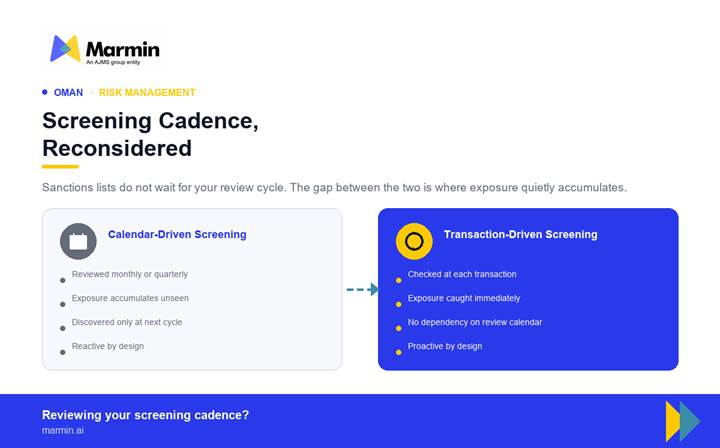
Two screening cadences and where exposure accumulates in each. Original graphic, Marmin brand style.
Where this connects to Oman’s UBO framework
Oman’s Ministerial Decision No. 245/2025 requires commercial companies to maintain a register of controllers for shareholders holding 25 percent or more equity, and to keep that register current. A UBO regime that expects registers to reflect current ownership is structurally mismatched to a screening process that only runs on a fixed calendar, since a change in a counterparty’s beneficial ownership between review cycles simply will not be caught until the next scheduled check, regardless of how significant that change might be.
AML and CFT oversight in Oman sits with the Central Bank of Oman for financial institutions, with the Financial Services Authority and Ministry of Justice and Legal Affairs covering other sectors, and reporting flowing through the National Center for Financial Information. None of these bodies mandate a specific screening frequency in the way they mandate the existence of a screening process, which is exactly why the cadence decision is left to each business and why it deserves more scrutiny than it typically receives.
What transaction-driven AML screening actually requires
Moving from a calendar-driven to a transaction-driven model does not require abandoning periodic reviews entirely. It requires adding a check at the points where risk actually changes: onboarding a new counterparty, before a significant transaction, or when ownership information is updated. This is a smaller technical lift than it sounds, since most modern screening tools already support this mode, and the barrier is usually process design rather than technology cost.
The more common obstacle is organizational rather than technical: screening has historically been owned by a compliance function that runs on its own calendar, largely independent of how quickly finance or operations teams move. Shifting to transaction-triggered screening means those functions need a shared trigger point, typically the onboarding or transaction system itself, rather than compliance operating as a separate downstream check. That coordination is usually the real project, and it is worth resourcing accordingly rather than treating the shift as a simple settings change inside an existing screening tool.
Practical recommendations
- Audit your current AML and UBO screening cycle and calculate the realistic gap between a sanctions list update and your next scheduled check.
- Evaluate whether your existing compliance tooling supports transaction-triggered screening rather than only periodic batch review.
- Align UBO register updates with actual ownership changes as they occur, rather than waiting for a fixed reporting calendar.
- Treat this review as a natural companion to Fawtara readiness work, since both involve re-examining how continuously your compliance processes need to operate.
What organizations should do now
This is not a regulatory requirement with an imposed deadline in the way Fawtara’s phases are. It is an operational gap that persists until a business chooses to close it, which means the businesses that address it proactively are doing so because the exposure itself is the motivation, not an external mandate. Given how directly this connects to Oman’s UBO register obligations, it is a gap worth closing on its own timeline rather than waiting for an incident to force the issue.
The Marmin perspective
As Fawtara brings continuous, transaction-level reporting into e-invoicing services in oman, it is a natural moment for compliance teams to examine whether their broader risk-screening cadence keeps pace with the same standard. This piece has focused on the industry-wide shift toward continuous screening as a discipline in its own right, distinct from any specific vendor’s offering, since the underlying principle applies regardless of which tools a business ultimately selects to implement it.
This piece reflects publicly available regulatory information as of August 2026 and is provided for general informational purposes only. It does not constitute legal, tax, or compliance advice. Organizations should confirm current requirements directly with the relevant regulator before making implementation decisions.

Leave a Reply