

Ministerial Resolution No. 66 of 2026 extended when you must appoint a provider. It left the date you must actually be live exactly where it was.
In May 2026, the UAE Ministry of Finance extended the deadline for large businesses to appoint an accredited service provider, moving it from 31 July 2026 to 30 October 2026 under Ministerial Resolution No. 66 of 2026. For many finance teams, that extension registered as welcome breathing room. It is worth being precise about what actually moved, because the mandatory go-live date for those same businesses, revenue at or above AED 50 million, remains 1 January 2027, entirely unchanged by the extension. Come lets see how Marmin can assist you in this.
Why this distinction matters more than it first appears
The ASP appointment deadline and the mandatory go-live date are two different milestones, and treating the extension of one as extra time on the other is a natural but costly misreading. The appointment deadline marks when a business must have formally selected and engaged an accredited service provider. The go-live date marks when that business must actually be transacting compliantly through that provider. The extension gave businesses three additional months to complete vendor selection. It gave zero additional days to complete the technical integration, testing, and internal process changes that have to happen between selection and go-live.
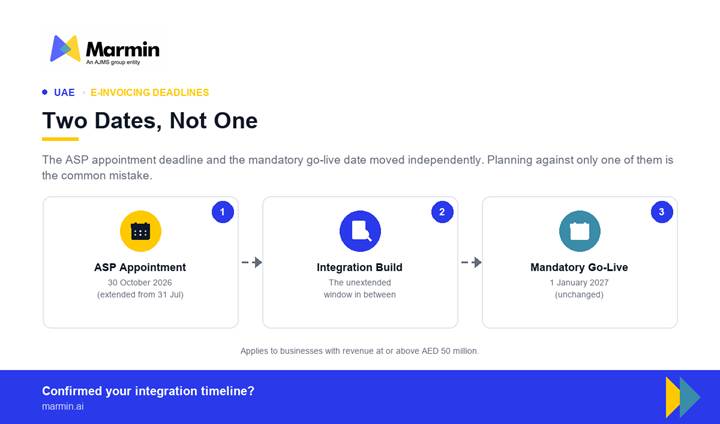
The ASP appointment deadline and mandatory go-live date, and the unextended window between them. Original graphic, Marmin brand style.
The math that makes this concrete
A business that appoints its provider on 30 October 2026, using the full extended window, has just over two months to complete integration and testing before the 1 January 2027 go-live date. That is a materially tighter implementation window than a business faced under the original 31 July 2026 deadline, which allowed roughly five months between appointment and go-live. In effect, the extension has compressed, not expanded, the realistic implementation timeline for any business that uses the full extension before selecting a provider.
This is not a criticism of the extension itself, which likely reflects a reasonable response to accreditation capacity constraints across the market. It is a reason for CFOs specifically to resist treating the later appointment deadline as license to delay the decision. The businesses in the strongest position are those appointing a provider well before 30 October 2026, preserving a realistic integration window rather than consuming the extension as additional planning time.
What this means for a mixed-timeline organization
For groups spanning multiple entities, some above and some below the AED 50 million threshold, this deadline structure adds a layer of internal complexity worth planning for explicitly. Entities above the threshold face the October 2026 and January 2027 dates described here. Entities below it have until 31 March 2027 to appoint a provider and until 1 July 2027 to go live. Coordinating implementation across entities on different timelines, potentially with a single provider relationship covering the whole group, requires a project plan that accounts for both tracks rather than treating the group as a single undifferentiated deadline.
Practical recommendations
- Treat 30 October 2026 as a deadline you should beat by a comfortable margin, not a date to use in full, given the compressed integration window it leaves before 1 January 2027.
- Build your internal project timeline backward from the go-live date, not forward from the appointment deadline, to keep the real constraint visible.
- For multi-entity groups, map which entities fall into which threshold tier now, and build a coordinated implementation plan rather than treating each entity’s deadline in isolation.
- Confirm with your chosen ASP how much lead time they realistically need for integration and testing, and work backward from go-live using that figure, not an assumed minimum.
What organizations should do now
The extension was a response to market-wide accreditation and implementation capacity constraints, which means the businesses still waiting to select a provider are competing for the same limited implementation resources that motivated the extension in the first place. Moving early is not just about preserving your own integration window. It is about avoiding a second, informal capacity constraint as the extended deadline approaches and demand concentrates.
The Marmin perspective
Marmin is a UAE Ministry of Finance pre-approved e-invoicing service provider and certified Peppol Access Point, among roughly thirty-two providers accredited as of the May 2026 extension announcement. Marmin, an AJMS Group company, is one option for businesses working to appoint a provider well ahead of the October 2026 deadline, preserving the fuller integration window a January 2027 go-live requires.
This piece reflects publicly available regulatory information as of August 2026 and is provided for general informational purposes only. It does not constitute legal, tax, or compliance advice. Organizations should confirm current requirements directly with the relevant regulator before making implementation decisions.

Leave a Reply