
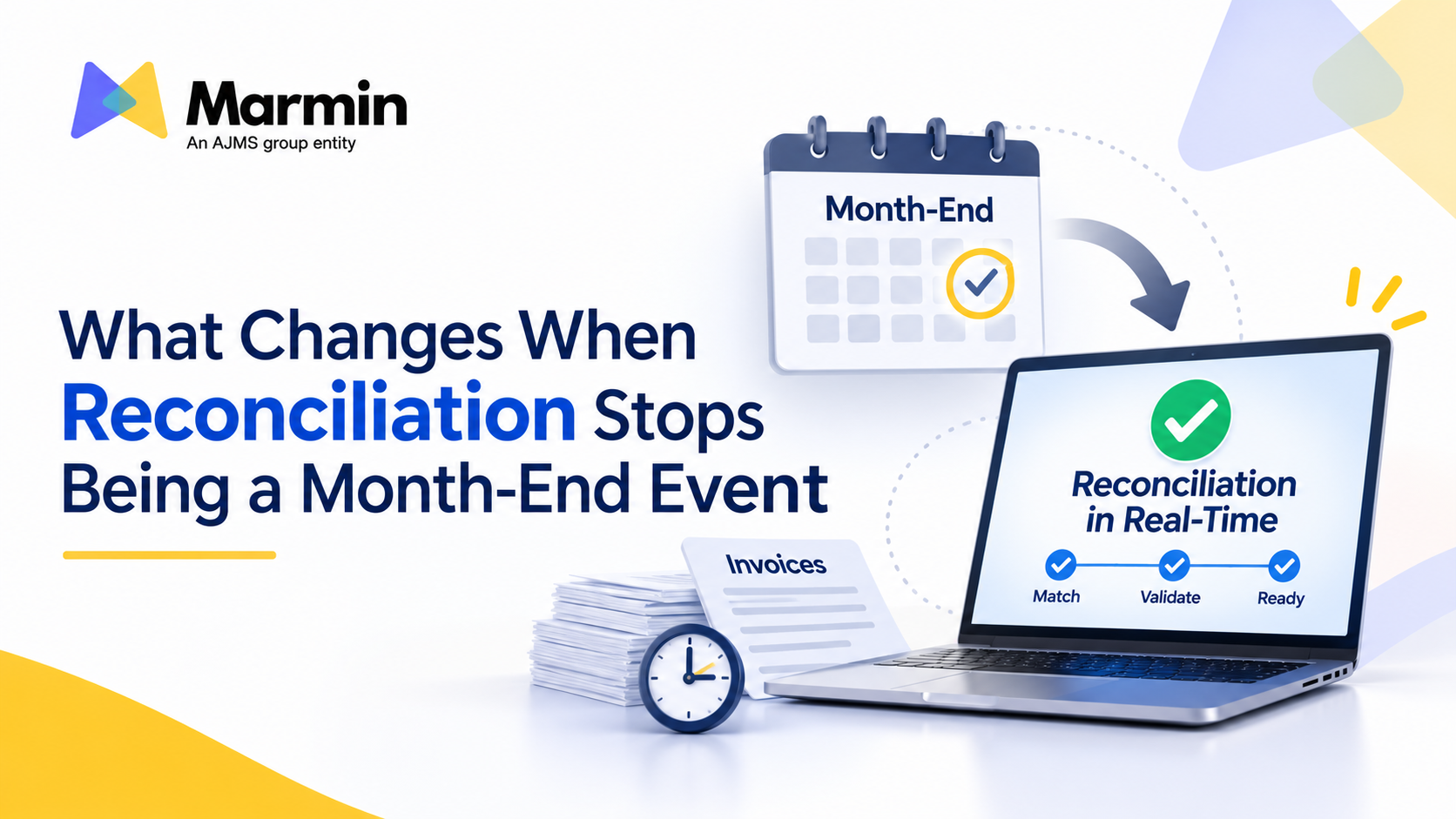
The month-end close was built around data arriving in batches. Fawtara in oman removes the batch, and with it, the reason the close needed to be monthly at all.
The month-end close is one of the most deeply embedded rituals in corporate finance, and it is worth asking a question rarely posed directly: why monthly? The honest answer, for most businesses, has little to do with any inherent financial logic and everything to do with the pace at which underlying data historically arrived. Invoices were issued and received in batches. Bank statements were reconciled periodically. VAT returns were filed on a schedule. Monthly was simply the cadence that matched how fast the underlying information moved. Fawtara quietly removes that constraint, and the close process built around it starts to look less necessary than it once was.
Why continuous invoicing breaks the batch assumption
Once e-invoicing under Fawtara becomes mandatory, invoice data moves continuously rather than in batches, validated and confirmed by the Oman Tax Authority as transactions occur rather than accumulated and processed periodically. This does not automatically make monthly closing wrong. It does mean the batch-based assumption that originally justified the monthly cadence no longer holds for at least one major input into the close process, invoice and transaction data, even while other inputs may still arrive on their old schedules.
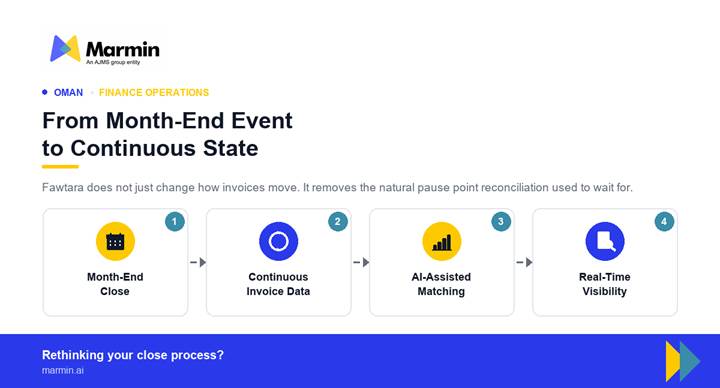
How continuous invoice data changes what the close process can become. Original graphic, Marmin brand style.
Where AI-assisted matching actually fits
This is where AI-assisted reconciliation tools genuinely earn their place, not as a generic automation upgrade, but as a specific response to a specific problem: continuous invoice data arriving faster than a manual, batch-oriented matching process can absorb. Matching invoices against bank data and VAT filings at the pace Fawtara now generates that data is not realistically a manual task at scale. AI-assisted matching, applied to well-structured, continuously arriving data, can perform this work at the pace the data itself now moves, flagging exceptions as they occur rather than surfacing them in a monthly batch review.
It is worth being precise about what this does and does not replace. It does not eliminate the need for human judgment on genuine exceptions, disputed invoices, or unusual transactions. It removes the artificial delay between when a discrepancy occurs and when a human first sees it, which is often the more consequential change, since early detection is usually what determines whether an issue is a minor correction or a compounding problem.
What actually changes for a finance team
The practical shift is not that the month-end close disappears entirely. Statutory reporting obligations, board reporting cycles, and external audit requirements still operate on periodic schedules that continuous data does not eliminate. What changes is that the close stops being the first moment discrepancies are discovered. Reconciliation becomes an ongoing state the business maintains continuously, and the monthly or quarterly close becomes a formal reporting exercise built on numbers that were already substantially reconciled in real time, rather than a scramble to reconcile a month’s worth of accumulated data under deadline pressure.
This distinction matters because it reframes what the close is actually for. A close built to discover problems is fundamentally a detective process, reactive by design, and its length and difficulty scale with how much has gone undetected during the period it covers. A close built on continuously reconciled data becomes a confirmatory process instead, verifying and formally reporting a financial position the business already understood in near real time. The statutory deadline stays the same. The amount of genuine work compressed into the days before it does not.
Practical recommendations
- Separate the question of statutory reporting cadence, which is unlikely to change, from reconciliation cadence, which Fawtara gives businesses genuine reason to make continuous.
- Evaluate AI-assisted matching tools specifically for their ability to handle continuous data streams, not just batch imports, since that is the actual gap Fawtara creates.
- Redesign exception escalation to happen as discrepancies are flagged, rather than accumulating them for a periodic review meeting.
- Use the current voluntary pilot period to test a continuous reconciliation workflow at low stakes before your mandatory phase begins.
What organizations should do now
Finance teams that treat this shift only as a technical side effect of Fawtara compliance will miss the larger opportunity it presents. The businesses that redesign their reconciliation process around continuous data, rather than simply connecting to OTA and leaving the rest of the close process unchanged, will find themselves with materially better visibility into their financial position at any given moment, not just at month end.
The Marmin perspective
Marmin’s platform includes automatic VAT and tax reconciliation with real-time discrepancy flagging, built specifically around the continuous data pattern Fawtara and comparable e-invoicing mandates create. Marmin, an AJMS Group company and UAE Ministry of Finance fully approved e-invoicing asp, applies this approach across its confirmed markets. It is a relevant reference point for Omani finance teams reconsidering what their own close process should look like once invoicing itself stops being a periodic event.
This piece reflects publicly available regulatory information as of August 2026 and is provided for general informational purposes only. It does not constitute legal, tax, or compliance advice. Organizations should confirm current requirements directly with the relevant regulator before making implementation decisions.

Leave a Reply