
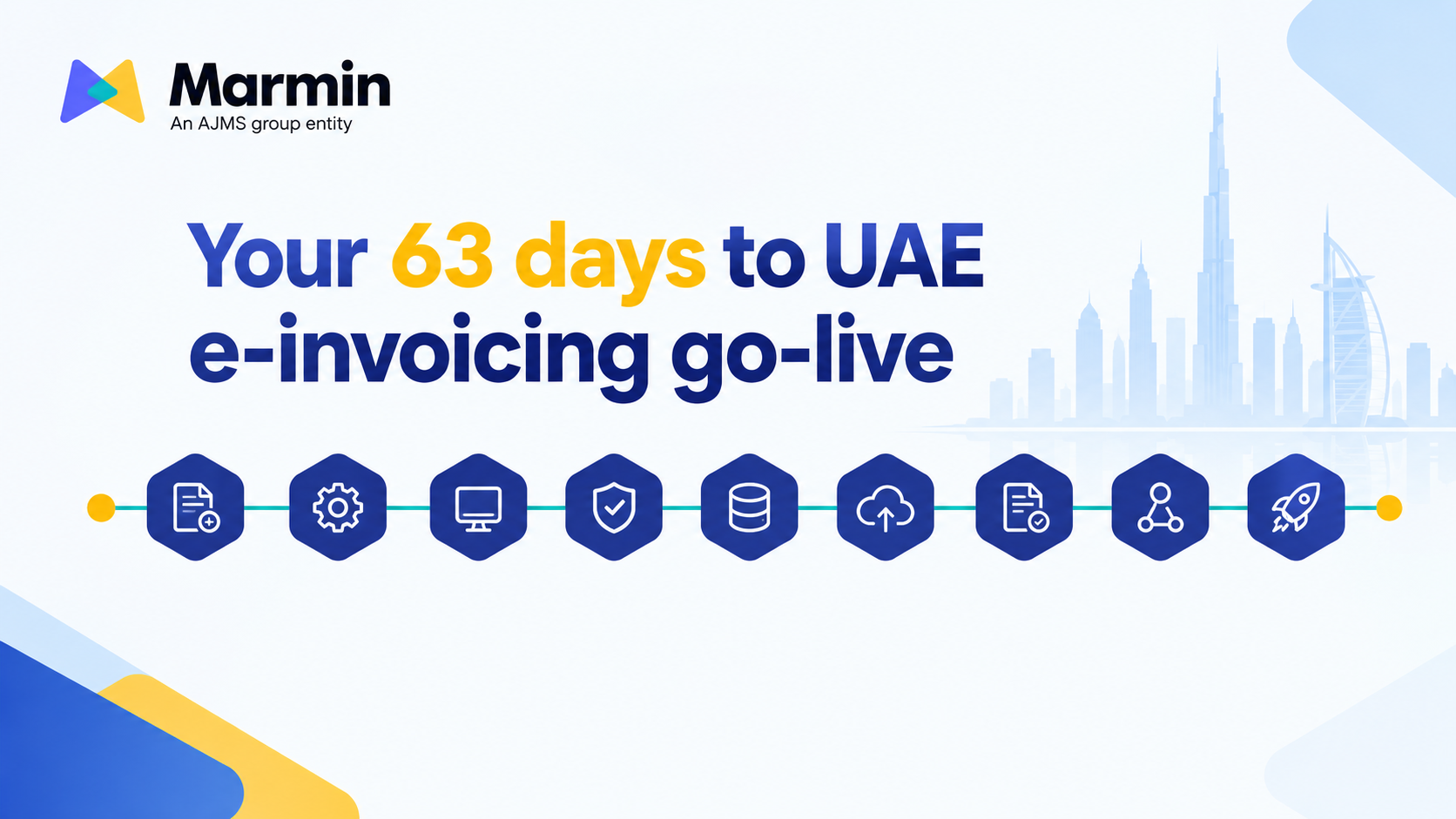
This applies to the UAE for e-invoicing. If your annual revenue is AED 50 million or more, appoint your Accredited Service Provider in UAE on EmaraTax by 30 October 2026, then use the 63 days to 1 January 2027 in three blocks: setup and data checks, testing around the year-end close, and a go-live check.
Who does this 63-day plan apply to, and which date is yours?
This plan applies to UAE businesses with annual revenue of AED 50 million or more, who must appoint an ASP by 30 October 2026 and be live on 1 January 2027.
Businesses below AED 50 million have a later track: appoint an ASP by 31 March 2027 and go live on 1 July 2027. Government entities appoint by 31 March 2027 and go live on 1 October 2027.
The go-live date for the AED 50 million group did not move. Only the appointment date did, from 31 July 2026 to 30 October 2026. That leaves 63 days between the two dates, so the plan below is built around that fixed end point.
What has to be decided by 30 October, and who does it on EmaraTax?
By 30 October you must choose your ASP, and your business selects it and starts onboarding itself through the Federal Tax Authority’s EmaraTax portal.
We suggest naming one person who holds the EmaraTax access and one person in finance who signs off the choice. This is a practical suggestion, not a requirement. Appointing an ASP does not transfer responsibility. Your business stays responsible for e-invoice values, compliance and record retention, so the selection should involve tax as well as IT.
One source indicates that a single ASP is appointed for both sending (receivables) and receiving (payables). Confirm this with your provider before you decide, because it affects who needs to be in the room.
What should the first two to three weeks after appointment cover?
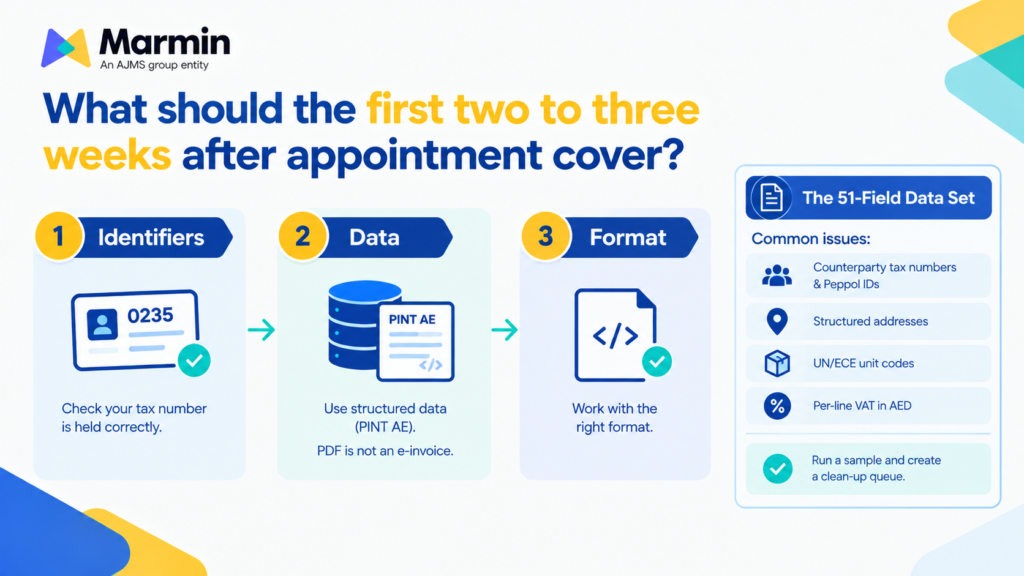
The first weeks should cover your identifiers, your data and your format, in that order.
Your Peppol participant identifier is 0235 followed by your 10-digit tax number, so start by checking that your tax number is held correctly in your master data. An e-invoice is issued, transmitted and received in a structured data format (PINT AE). A PDF is not an e-invoice, so your current PDF output cannot be treated as a starting point for go-live.
One source puts the data set at 51 mandatory fields and lists the items that fail most often:
– validated tax numbers and Peppol identifiers for counterparties
– structured addresses
– UN/ECE unit codes
– per-line VAT in AED
Run a sample of real customer and supplier records against that list and give IT a clean-up queue.
How do you fit e-invoicing testing around the year-end close?
Split the 63 days so that setup finishes before the close peaks, and keep test volumes small and repeatable during the close.
From 30 October to 1 January is about nine weeks, and it includes the year-end close. Finance will have limited time late in the window, so move data fixes and sign-offs to the early weeks. Use the later weeks for short test cycles on a few document types and a few counterparties.
Set your timing rule early. Businesses that are not VAT-registered must issue and transmit within 14 days of the transaction. VAT-registered businesses follow the VAT time-of-supply rules, and your tax team should confirm how those rules apply to each document type.
What do the 1 October amendments change for your plan, including VAT groups and data storage?
The amendments, announced by the Ministry of Finance on 19 October 2026 and in effect since 1 October 2026, change three items: intra-group VAT group transactions are excluded for 24 months, data no longer has to be stored in the UAE, and the system failure notification duty was repealed.
First, transactions between members of the same VAT tax group are excluded from mandatory e-invoicing for 24 months, from 1 January 2027 to 31 December 2028. Transactions with parties outside the group follow the normal phase dates. One source indicates that VAT group members must each be onboarded separately, so confirm that point for your group.
Second, e-invoice data no longer has to be stored inside the UAE. You must still keep e-invoices, e-credit notes and related data for the period in the Tax Procedures Law and provide them to the Federal Tax Authority on request.
Third, the duty to notify the Federal Tax Authority of a system failure within two business days was repealed. Responsibility for compliance and record retention still sits with your business.
What should be running by 1 January, and how do you check it?
By 1 January 2027 you should be sending and receiving e-invoices in PINT AE through your appointed ASP, with the checks below already passed.
Use this as a go-live list:
– your Peppol identifier is correct and live
– the mandatory fields populate from source data without manual fixes
– your timing rule is applied (14 days if not VAT-registered, time-of-supply rules if VAT-registered)
– same-VAT-group transactions are separated from external ones
– retention of e-invoices, e-credit notes and related data is assigned to a named owner
B2C transactions are excluded for now, so keep them out of your test scope. Because responsibility stays with your business, have finance review a sample of live e-invoices in the first days after go-live.
How does Marmin AI make this work simple?
Marmin AI, an AJMS Group entity, is the UAE’s First Fully Approved Accredited Service Provider (ASP) for E-Invoicing, with 100% UAE data residency.
Marmin AI is also a Fully Approved ASP under Oman’s Fawtara programme and has an established presence across the UAE, Oman, Bahrain, India, Malaysia, Belgium and beyond.
Your business remains responsible for e-invoice values, compliance and record retention. Talk to the Marmin team about your 63 days and how to sequence each step.
Book a 20-minute demo at marmin.ai or call +971 4 554 2733 to plan your 63 days.

Leave a Reply