
Many UAE groups include entities on both sides of the AED 50 million threshold. That means two separate compliance clocks running inside one finance function.
UAE e-invoicing deadlines are structured around a single revenue threshold, AED 50 million, that determines which of two compliance timelines a business follows. For a single standalone company, this is a simple classification exercise. For a group with multiple legal entities, some above and some below the threshold, it means managing two genuinely separate compliance clocks inside what is often a single, shared finance function.
The two clocks, side by side
Entities with revenue at or above AED 50 million must appoint an accredited service provider by 30 October 2026 and be live by 1 January 2027. Entities below that threshold have until 31 March 2027 to appoint a provider and until 1 July 2027 to go live. These are not approximate windows. They are the specific dates set under the current governing instruments, and a group with entities on both sides of the threshold is legally required to meet both sets of dates independently, even if the entities share finance staff, systems, or a single ERP instance.
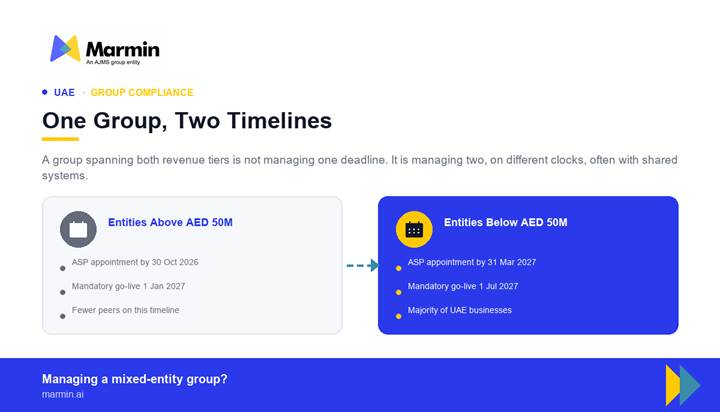
The two compliance timelines a mixed-entity group must manage simultaneously. Original graphic, Marmin brand style.
Why this creates real project management complexity
The natural instinct for a shared finance function is to build one UAE e-invoicing software implementation project and apply it group-wide, and there is genuine efficiency in doing so. The complication is that the larger entities’ January 2027 go-live effectively sets the real deadline for any shared infrastructure, since that infrastructure needs to be ready for the earlier-deadline entity regardless of whether the smaller entity’s own deadline is still months away. This means a mixed-entity group cannot simply plan around its latest deadline. It has to plan around its earliest one, even if that entity represents a smaller share of overall group revenue.
There is also a sequencing decision worth making deliberately: whether to bring smaller entities live alongside the larger ones ahead of their own deadline, capturing efficiency from a single rollout, or to stagger the implementation and treat each entity’s deadline independently. Neither approach is universally correct. The right choice depends on how much shared infrastructure genuinely exists across entities and how much internal capacity is available to run a single combined project versus two sequential ones.
Governance structure matters here too. In many groups, individual entities retain their own finance leadership even when infrastructure is shared, which means a single implementation project needs sign-off and coordination across multiple decision-makers who may not otherwise interact closely on operational matters. Establishing a single accountable owner for the group-wide e-invoicing project, with clear authority to make timeline and vendor decisions on behalf of all entities, tends to prevent the coordination delays that otherwise emerge when each entity treats the project as its own separate initiative.
Practical recommendations
- Map every legal entity in your group against the AED 50 million threshold now, and confirm that classification is based on current, accurate revenue figures rather than assumption.
- Build your master implementation timeline around the earliest applicable deadline across all entities, not the latest.
- Decide deliberately whether to bring all entities live together or stagger by entity, based on shared infrastructure and internal project capacity, rather than defaulting to whichever approach seems administratively simplest.
- Confirm with your chosen ASP whether their platform and contract structure genuinely support a multi-entity group efficiently, since not every provider is built for that use case.
What organizations should do now
Groups that have not yet mapped their entities against the threshold are at risk of discovering, closer to the earlier deadline, that the project scope is larger than assumed. This mapping exercise is straightforward and should happen immediately, independent of any other implementation planning, because it determines the actual shape of the project every other decision depends on.
The Marmin perspective
Marmin’s multi-country dashboard and ERP-agnostic connectors are built to support businesses operating across multiple entities and jurisdictions from a single platform relationship. Marmin, an AJMS Group company and UAE Ministry of Finance pre-approved e-invoicing service provider, is one option for groups seeking to manage a mixed-entity rollout without building separate provider relationships for each threshold tier.
This piece reflects publicly available regulatory information as of August 2026 and is provided for general informational purposes only. It does not constitute legal, tax, or compliance advice. Organizations should confirm current requirements directly with the relevant regulator before making implementation decisions.

Leave a Reply