

Oman’s Fawtara voluntary pilot begins within weeks. What happens during it will tell finance leaders more about 2027 readiness than any timeline chart.
Oman’s e-invoicing programme, e invoicing in Oman, Fawtara, is entering its most consequential phase yet. A voluntary pilot involving an estimated 100 to 150 pre-notified large taxpayers begins at the end of August 2026, months ahead of the mandatory phases that follow through 2027. For CFOs whose businesses sit outside that initial pilot group, it is tempting to treat this as someone else’s problem: a technical dry run happening at other companies, on someone else’s finance stack. That reading understates what the pilot actually is. It is the only opportunity anyone will get to see how Fawtara behaves under real transaction volume before the mandate becomes binding for everyone else.
What the pilot actually tests
Under Decision No. 189/2026, issued by the Oman Tax Authority (OTA) on 9 August 2026, the pilot is explicitly non-mandatory and limited to a defined group of large taxpayers. Mandatory compliance follows in two phases: businesses with annual supplies exceeding OMR 5 million must comply from 1 April 2027, with all remaining VAT-registered businesses following from 1 October 2027. This is a meaningfully different timeline from the four-phase rollout that circulated in earlier 2026 vendor commentary, which described a staged rollout beginning in August 2026 itself. That framework has been superseded, and finance leaders still working from mid-2026 sources may be planning against dates that no longer apply.
The technical foundation is Peppol. OTA became an official Peppol Authority in January 2026 and published its Oman-specific technical specification, PINT-OM, in April 2026. Structurally, Fawtara uses what is known as a five-corner model: invoices move from the supplier to the supplier’s accredited service provider (ASP), across the Peppol network, to the buyer’s ASP, and finally to the buyer, while both service providers simultaneously transmit a Tax Data Document to OTA. That fifth corner is what turns e-invoicing from a bilateral commercial exchange into a live reporting relationship with the tax authority, and it is exactly the mechanism the pilot exists to stress-test.
Why this matters even if you’re not in the pilot group
For a CFO, the practical question the pilot answers isn’t whether Peppol works as a network. It demonstrably does, across the markets where it has already been implemented. The question is how OTA’s specific implementation behaves under real invoice volume: how quickly validation errors surface, how exceptions get resolved, and whether the grace period OTA has confirmed in principle, though has not yet published a duration for, gives businesses enough runway to correct issues without commercial disruption. None of that is knowable from a specification document alone. It only becomes visible once real invoices start moving through the system.
There is also a market-timing dimension worth naming plainly. Eighteen or more accredited service providers are already active in Oman. Businesses that begin evaluating and selecting a provider now, well ahead of the April 2027 Phase 1 deadline, are choosing from that field with far less competing demand on implementation teams than businesses that wait until the deadline is closer and every other mid-sized company in the country is trying to onboard at the same time.
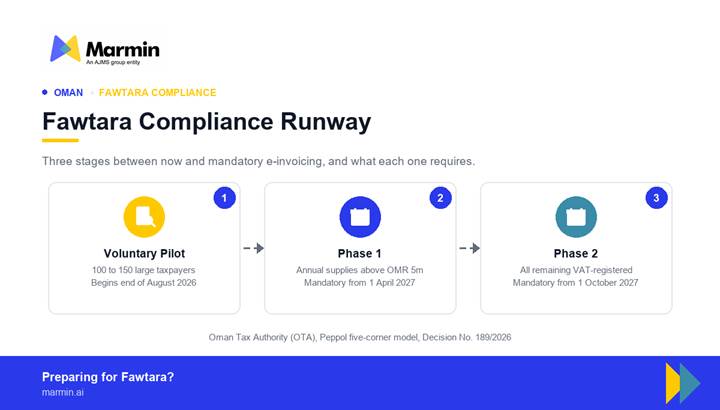
Fawtara’s current compliance runway under Decision No. 189/2026 (issued 9 August 2026). Original graphic, Marmin brand style.
Practical recommendations
- Map your invoice volume and the systems generating it now, independent of whether you fall into Phase 1 or Phase 2. Phase 1 businesses currently face a less contested implementation market than they will closer to the deadline.
- Track pilot outcomes as OTA publishes them, rather than relying solely on OTA’s own FAQ resources, since the agency’s public portal was still displaying superseded timeline information for several days after the binding 9 August 2026 decision.
- Treat ASP selection as a systems decision, not a compliance form: evaluate integration approach (API, bulk upload, or SFTP), reconciliation tooling, and multi-jurisdiction support if you operate beyond Oman, not accreditation status alone.
- Build your reconciliation process around continuous, not batch, invoice flow. This is a larger operational shift for most finance teams than the mandate date itself suggests.
What organizations should do now
Even for businesses that fall into Phase 2, mandatory only from October 2027, the realistic planning window is shorter than the calendar suggests. Vendor selection, ERP connectivity work, and staff process changes take months, not weeks. Organizations that begin that work now, while the pilot is still generating real-world lessons, arrive at their own go-live date with a materially calmer, better-informed implementation than those who wait for the deadline to force the decision.
The Marmin perspective
Organizations preparing for mandatory e-invoicing increasingly need a single, accredited layer that connects compliance, finance operations, and data integrity, rather than treating each requirement as a separate project. Marmin, an AJMS Group company, operates as a certified Peppol Access Point and is a UAE Ministry of Finance pre-approved e-invoicing service provider, giving it direct operating experience with the same Peppol five-corner architecture that underpins Fawtara. As Oman’s mandate takes shape, that cross-market Peppol experience is a relevant reference point for Omani finance teams evaluating how a multi-jurisdiction compliance platform behaves in production, not only on a specification sheet.
This piece reflects publicly available regulatory information as of August 2026 and is provided for general informational purposes only. It does not constitute legal, tax, or compliance advice. Organizations should confirm current requirements directly with the relevant regulator before making implementation decisions.

Leave a Reply