
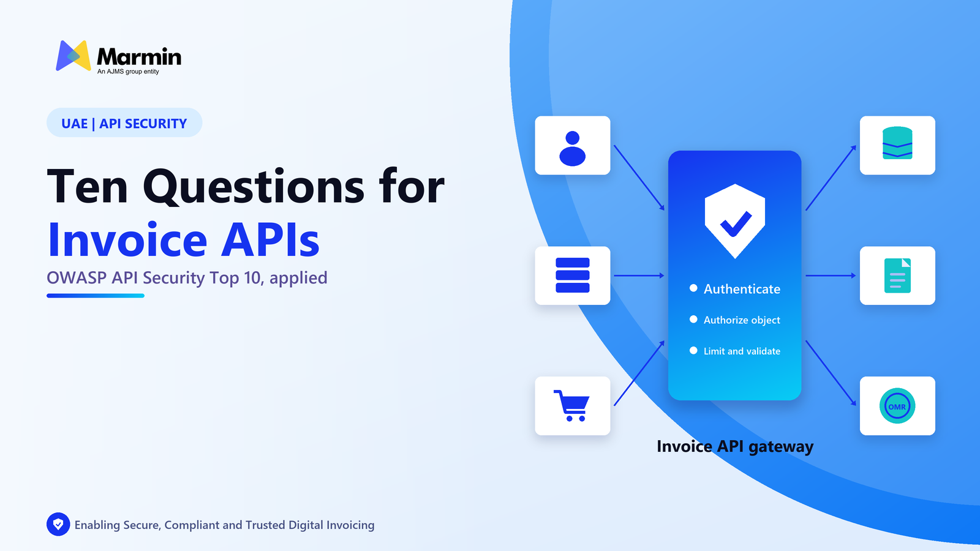
Most UAE e- invoicing businesses will connect their ERP, billing or procurement system to an Accredited Service Provider through an application programming interface. That interface submits invoices, retrieves statuses and, in some set-ups, issues credit notes. It is a doorway into financial data, and doorways get tested.
The OWASP API Security Top 10 (2023 edition, still the latest) is a widely used checklist of the most common API weaknesses. It is a benchmark, not a UAE legal requirement, but it translates neatly into ten questions for a finance and IT team preparing for e-invoicing.
Ten risks, ten questions
| OWASP risk (2023) | How it appears in e-invoicing | The question to ask |
| API1 Broken Object Level Authorization | Changing an invoice identifier returns another entity’s invoice | Is every request checked against the caller’s right to that specific invoice? |
| API2 Broken Authentication | Weak token handling or password recovery on the integration account | How are tokens issued, rotated and revoked? |
| API3 Broken Object Property Level Authorization | A response exposes bank details or personal contact fields to callers who do not need them | Which fields can each role read or change? |
| API4 Unrestricted Resource Consumption | Bulk submissions or huge files flood the service at month end | What limits apply to size, rate and concurrency? |
| API5 Broken Function Level Authorization | An ordinary user reaches a function that issues credit notes or changes status | Which roles can call which functions, and is it enforced server side? |
| API6 Unrestricted Access to Sensitive Business Flows | Automated creation of invoices or credit notes at scale | Which flows are valuable to abuse, and how are they rate limited and monitored? |
| API7 Server Side Request Forgery | A callback or webhook address supplied by a client makes the server call internal systems | Are callback destinations validated against an allow list? |
| API8 Security Misconfiguration | Verbose errors, permissive cross-origin settings or default credentials | Who reviews configuration before every release? |
| API9 Improper Inventory Management | An old test endpoint or version still serves live data | Do we have a complete list of endpoints and versions, and are retired ones switched off? |
| API10 Unsafe Consumption of APIs | Trusting a response from a third party without validation | Do we validate everything that comes back from the provider and from the ERP? |
Where the responsibility sits
The Ministry of Finance’s Guidelines are clear that the compliance obligation stays with the taxpayer, even though Accredited Service Providers carry out the technical activities. They also list agreeing business-specific data security requirements with the provider as a taxpayer task. Ministerial Decision 168 of 2026 sets minimum security criteria for the providers’ own product, including multifactor authentication for user access, encryption of data in transit and at rest, regular security monitoring and a valid ISO/IEC 27001 certification. Those criteria do not cover the endpoints you build on your own side, such as the integration layer between your ERP and the provider.
A scenario: a group with one shared integration layer
A holding company in Abu Dhabi routes invoices for four subsidiaries through one integration service. A developer adds a lookup endpoint that returns an invoice by number so that the shared service centre can check statuses. The endpoint checks that the caller is signed in but not which subsidiary the caller belongs to. A user from one entity can retrieve another entity’s invoices by guessing numbers. This is a textbook object level authorisation failure (API1), and it is exactly the kind of weakness a pre-go-live review should catch.
Security implications and recommendations
- Inventory first. List every endpoint, version and environment that touches invoice data, including test and sandbox systems.
- Authorise at the object and function level, not only at the front door, and test with accounts from different entities.
- Set limits. Cap payload size, rate and concurrency, and design month-end load tests with those limits switched on.
- Validate callbacks and responses. Allow-list callback destinations and treat provider responses as untrusted input.
- Test before go-live. Include the invoice APIs in the scope of a penetration test, and re-test after major changes.
OWASP’s REST Security Cheat Sheet adds practical detail: serve only over HTTPS, use mutual TLS for highly privileged services where appropriate, enforce request size limits, require supported content types, avoid credentials in URLs and return generic error messages.
Three quick experiments
- Take an invoice identifier belonging to one legal entity and request it while signed in as a user of another. The request should fail.
- Submit a file far larger than any real invoice, and a burst of requests in a short period. Both should be refused with a clear response, not slow the service for everyone else.
- Ask for a retired API version or a test endpoint by name. If either responds with production data, your inventory is incomplete.
Conclusion
The OWASP list will not find every flaw, but it is a disciplined way to start a conversation between finance and IT. Each question has a clear owner and a testable answer.
Run through the ten before your go-live date, and keep the answers as evidence that you took reasonable care.
Marmin AI Software Design LLC appears on the UAE Ministry of Finance’s published list of Accredited Service Providers. If you would like an independent look at how your e-invoicing connections handle security, speak to Marmin’s UAE team about a technical review.
SOURCES AND REFERENCES
- OWASP API Security Top 10, 2023 edition. OWASP API Security Project. https://owasp.org/API-Security/editions/2023/en/0x11-t10/
- REST Security Cheat Sheet. OWASP Cheat Sheet Series (accessed 10 November 2026). https://cheatsheetseries.owasp.org/cheatsheets/REST_Security_Cheat_Sheet.html
- UAE Electronic Invoicing Guidelines, Version 2.0 (26 October 2026). UAE Ministry of Finance. https://mof.gov.ae/wp-content/uploads/2026/10/UAE-Electronic-Invoicing-Guidelines_En.pdf
- Ministerial Decision No. 168 of 2026 on Eligibility Criteria and Accreditation Procedure for Service Providers. UAE Ministry of Finance, effective 1 October 2026. https://mof.gov.ae/wp-content/uploads/2026/10/Ministerial-Decision-No-168-of-2026-on-Eligibility-criteria-and-Accreditation-Procedure-EN-FINAL.pdf
Regulatory content reflects UAE Ministry of Finance, Federal Tax Authority and OpenPeppol documents as of 10 November 2026. Where this piece describes the PDPL, the cybercrime law or sector rules, it relies on secondary commentary because the official text could not be retrieved; please have UAE counsel confirm before external publication.

Leave a Reply