
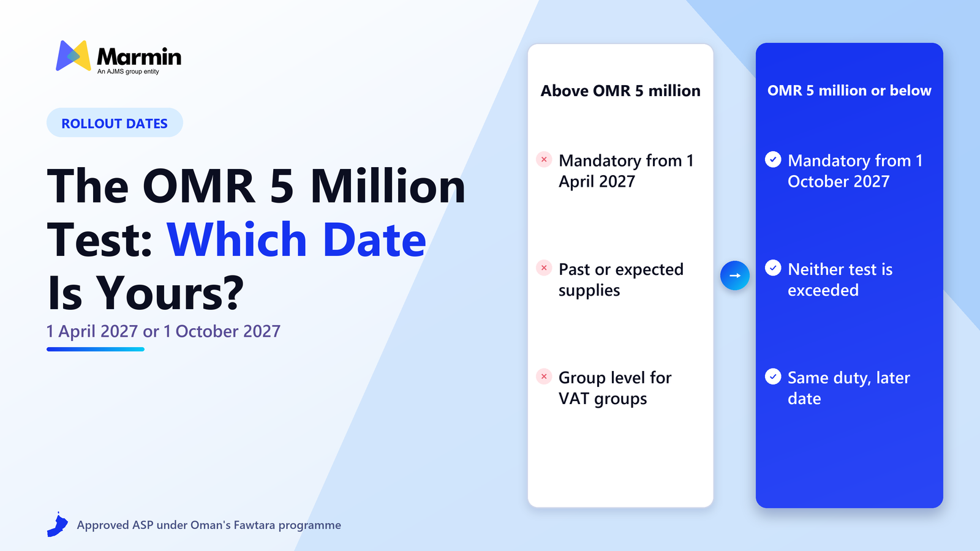
Under Decision 189/2026, every VAT-registered business has a start date for e-invoicing in Oman, and that date depends on a single number: OMR 5 million of annual supplies. Businesses above it start on 1 April 2027. Everyone else starts on 1 October 2027.
The Decision itself does not explain how to measure the figure. The Oman Tax Authority’s FAQ does, and the method has a feature that catches people out: it looks both backward and forward. Here is how it works as of 2 November 2026.
The reference date and the two ways to cross the line
The Tax Authority’s key reference is the total value of your annual supplies as of 31 March 2027. Your business starts on 1 April 2027 if either of the following is true:
- your supplies from 1 April 2026 to 31 March 2027 exceed OMR 5,000,000, or
- your expected supplies from 1 April 2027 to 31 March 2028 exceed OMR 5,000,000.
If neither is true, the October 2027 date applies. The second limb is the one that surprises growing businesses: a company that has not yet reached OMR 5 million can still fall into the April cohort if it expects to cross the line in the following twelve months.
What counts as a supply for this test
The FAQ lists the categories that count: taxable supplies excluding supplies of capital assets, supplies under the reverse charge, and intra-GCC supplies of goods and services. Non-resident businesses count only their supplies made in Oman. Businesses in a VAT group are assessed at group level, not member by member.
Three illustrative scenarios
The following examples are hypothetical and use round numbers to show the logic.
| Scenario | What the test looks at | Likely outcome |
| A trading company with OMR 4.6 million of supplies last year, forecasting OMR 5.4 million next year | Backward figure is below the line, forward expectation is above it | 1 April 2027, because the expected supplies exceed OMR 5 million |
| A consultancy with steady supplies of about OMR 3 million | Neither the past nor the expected figure exceeds the line | 1 October 2027 |
| A VAT group of three companies with OMR 2 million of supplies each | Assessed as one group, so OMR 6 million combined | 1 April 2027 for the group, even though no single member is above the line |
A tool from the Tax Authority, with a caveat
The Tax Authority offers a Potential Rollout Checking tool on its Tax Portal. You enter your VAT number and choose between two supply bands, OMR 0 to 5 million or above OMR 5 million. The page states that it is provided for awareness, preparation and readiness purposes only. Use it as a prompt for internal analysis, not as a final determination.
Where the uncertainty remains
The Decision does not itself define how annual supplies are calculated. The FAQ fills that gap, but the FAQ is guidance and the Tax Authority can update it. Professional commentary has noted the same gap, so it is sensible to document how your finance team arrived at its figure and to keep that record with your readiness plan.
What your date means for the project plan
Nothing in Decision 189/2026 makes e-invoicing mandatory before 1 April 2027, so work done before that date is voluntary. The Tax Authority nevertheless encourages taxpayers to start testing before their mandate date, and has said that participating early helps businesses become familiar with the process. For the April cohort, the practical window between now and the start date is short enough that provider selection, system connection and testing need to run in parallel. For the October cohort, the longer runway is an opportunity to learn from the first businesses to go live, provided the preparation is actually scheduled.
Common slips to avoid
- Looking only at last year. The forward looking limb applies to expected supplies from April 2027.
- Forgetting the group. If your business is part of a VAT group, the group total is what matters.
- Leaving out categories. Reverse charge and intra-GCC supplies are on the Tax Authority’s list.
- Treating the later date as a free pass. The duty is the same for both cohorts. Only the start date differs.
A four step working checklist
- Extract your supplies for 1 April 2026 to 31 March 2027, split by the categories the Tax Authority lists.
- Prepare a forward estimate for 1 April 2027 to 31 March 2028, with the assumptions written down.
- Confirm whether your business is part of a VAT group, and if so, gather the group figures.
- Record the method, the date and the approver, and keep the working with your readiness plan.
Conclusion
Knowing your date early changes the quality of every decision that follows, from budget timing to provider selection to how much of your testing can happen before the mandate begins.
For some businesses the answer will be obvious. For others, particularly growing companies and VAT groups, it is worth a short working session between finance, tax and your adviser to settle it and write it down.
Marmin AI Oman team can help you document your cohort and turn it into a plan. Ask for a readiness review and bring your last twelve months of supply data.
SOURCES AND REFERENCES
- Decision No. 189/2026 amending certain provisions of the VAT Executive Regulations (Arabic text), Official Gazette issue 1660. Oman Tax Authority, published by the Ministry of Legal Affairs. https://www.mjla.gov.om/images/decisions/file/Book934177.pdf
- Fawtara (E-invoicing) Frequently Asked Questions, version dated 30 September 2026. Oman Tax Authority. https://tms.taxoman.gov.om/portal/documents/d/taxportal/monthly-faq-s-september-
- E-invoicing FAQs, web page last updated 28 October 2026. Oman Tax Authority Tax Portal. https://tms.taxoman.gov.om/portal/e-invoicing-faq
- Potential Rollout Checking. Oman Tax Authority Tax Portal (for awareness and readiness only). https://tms.taxoman.gov.om/portal/potential-rollout-checking
- Oman Tax Authority amends VAT Executive Regulations (professional commentary, secondary source). KPMG Oman, August 2026. https://kpmg.com/om/en/insights/2026/08/oman-tax-authority-amends-vat-executive-regulations.html
Regulatory information in this piece is current as of 2 November 2026 and is drawn from the Oman Tax Authority and OpenPeppol documents listed above. Where this piece reflects our plain-language reading of the Arabic text of Decision 189/2026, please have legal counsel confirm exact wording before relying on it. Requirements and dates can change, so confirm against the Oman Tax Authority’s current publications before acting.

Leave a Reply